A personal diary keeping people abreast of what I am working on writing-wise.

Monday, August 18, 2003

REACH OUT AND TOUCH FAITH (NOMADIC REVERY 2)

The previous night’s excellent gyro was followed by an equally excellent Saturday morning eggs benedict. Food is good for the old and chubby.

In a fortuitous happenstance, our trip coincided with an exhibit on Indian and Pakistani art at the Seattle Art Museum. Rebecca studies Asian art, so this was perfect for her, and since she works at the Portland Art Museum, we were able to get in as part of the two institution’s reciprocal program. Some of the paintings dated back to the 16th century and they all came from the collection of one man, which is pretty amazing to think about. Many of them were done on small pieces of paper, put together as parts of albums, and often depicted famous stories from Indian culture—meaning lots of Krishna and Shiva and other important figures. They ranged from the romantic to the grotesque, and were full of vivid colors. There was also a much more obvious thread through time than in most Western cultures. It was easy to see how each generation informed the next, and they even had a side exhibit with two artists who were keeping tradition alive.

The opening act, Kenna, was awful—proving you can be produced by half the Neptunes and still sound like shit. I had heard his album over a year ago and declared him a poor Depeche Mode wannabe then—and said record has only just come out. The main problem is he has no variety to his presentation, vocally or musically. There are no peaks or valleys. He sings everything straight across. And his sincerity is overblown, leading him into bad poetry—as evidenced by his heartfelt story regarding the girl who had told him his song “Love Hate Situation” had inspired her to quit heroin. Rebecca wondered if she started heroin, if that would negate that good he had supposedly done. I said it would.

Coming out on his first solo tour for his first solo album, Paper Monsters, Gahan seemed ready to indulge in all of his rock star fantasies that years of being on stage with synthesizers and giant tape machines haven’t allowed. Not that he hasn’t been the peacock of Depeche Mode all along—it’s just now he got to do a “real” rock show, with a “real” rock band, and there would be no screaming for Martin Gore or anyone else. Just him. So, he followed the four piece in his signature suit pants and vest (which lasted maybe one song), opening with the awesome “Hidden Houses,” a song I never really paid much attention to on Paper Monsters, but that really came to life in this setting—while ironically, my favorite of his solo work, “Hold On,” seemed to lose some of its gentleness in the #2 slot. Right from the get-go, too, it was clear Gahan was going to let every impulse for audience participation be fulfilled. He’s always been known for the singalong (think the fantastic “Everything Counts” from Depeche Mode 101) and the “let me see your hands” arena rock gesture—and he wasted no time getting into that here. In fact, it came off as arrogant at first, expecting that everyone would be able to join in on the solo stuff—except they all could. Shows what I know. Still, was it really too much to ask for him to sing the title line from “Dirty Sticky Floors” at least once? It was his lead single, after all.
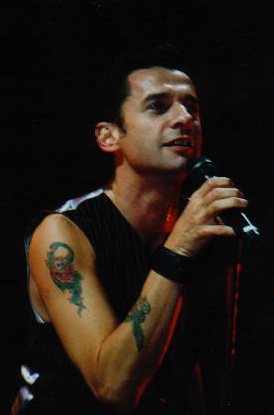

The bulk of the main set was from Paper Monsters. In fact, I think he played the whole album (though “Black & Blue Again” could have been skipped, as he weighted it down with harmonica and a little too much jamming). The fourth song was the first of seven from Depeche Mode, and it was instantly clear that Paper Monsters doesn’t cut the mustard when shoved up against his original band’s compositions. “A Question of Time” completely rocked, and it wasn’t just Dave onstage—shirtless and sweating, spinning around and doing his high kicks—it was the audience, too. As much as they hung on his every word, no matter the number, the surge of energy that came with a DM tune was immediately palpable.

The show really kicked into high gear, though, when Gahan laid into his second Depeche Mode number, “Walking in My Shoes.” He kept the energy on high after that, following with “I Need You” and “Bottle Living” from his own album, and capped by “Personal Jesus,” always the biggest audience participation number—with the majority of the crowd raising their hands in a symbolic reaching out to touch faith. Interesting that the set ended on a darker song, then—but “Goodbye” was one of the best things off of Paper Monsters when it came to the live setting. In fact, the slower numbers all took on more girth with the live band, especially “A Little Piece.”

Encore #1 was a stormer. “I Feel You” was a no-brainer when it came to guessing what Gahan would pull from the DM catalogue. The heavy rock riffs were tailor-made for Gahan Mk. II, the rock ‘n’ roll animal that nearly destroyed himself and the band in the mid-‘90s. He followed with “Never Let Me Down Again,” still one of the best DM singles. The keyboard player gave the main piano hook a more bluesy, deep sound.

On any given night, that encore would have been enough, but the band returned to perform another quick medley in a stripped down set. Playing a tiny organ, a halved drum kit, acoustic guitar, and stand-up bass, they crowded to the center stage while Gahan strutted through “Policy of Truth” and a fabulous “Enjoy the Silence” that segued into the first verse and chorus of “Just Can’t Get Enough” at the bridge. As a long-time fan, this was a real treat. It’s rare to hear the songs reinterpreted in such drastic ways (they recalled “Love In Itself 4” more than, say, the acoustic “Personal Jesus” or harmonium “Enjoy the Silence”).

Say what you want about Depeche Mode, or a lead singer having the hubris to go solo, but Gahan still knows how to command an audience. Part of it is not forgetting they are there. He had no problem plunging his hands into the crowd to shake a few. He even brought one girl on stage to dance with him during the start of the second encore. Perhaps the biggest testament to his stage presence was that Rebecca, who doesn’t know her DM from her OMD or even her ODB, was suitably impressed. Before the show she had asked if it was okay if she went and read in the bar if she didn’t like it; she stayed through the whole thing.

As an added bonus (if you want to call it that), we got a second show throughout Gahan’s set—the rather attractive and leggy blonde in the row in front of us who was rubbing herself and her feather boa all over her date through the entire show. She was clearly turned on by the performance, and she was going to take it all out on her companion. Eventually, he sat down for a while, and we debated whether he was just tired out from blue balls, or if he had accidentally gotten a little too happy in his pants and had to recharge. At that point, the girl—being a terrible tease—did turn around and stick her tongue out at him, and it seemed like it pissed him off a little. He looked like a guy out of a porno—a big dude with a flat, brick-wall nose (think Darwyn Cooke’s version of Slam Bradley), ears pierced with big gold hoops, and bleached blonde hair gelled down. I am glad I couldn’t here his pornstar grunting.

All in all, it was a packed weekend, with very little to disappoint. It was relaxing and got me away from work and other pressures—and it was two shows I wouldn’t have wanted to miss. I have no clever ending to tie it all up—except maybe to point out I had a bad processed chicken sandwich on the train, since the guy in front of me who looked like Wilford Brimley got the last pre-cooked hamburger. Could it have been downhill the whole way home?

Current Soundtrack: Kelis w/ P. Diddy & Richard X; Nick Cave & the Bad Seeds, The Good Son; The Primitives, Lovely


cut_my_hair@hotmail.com

Sunday, August 17, 2003

NOMADIC REVERY (ALL AROUND)

Friday afternoon, Rebecca and I boarded a train for Seattle. We had been looking forward to this weekend all summer. Bjork was playing on the pier in Seattle that night, and we were going to see Dave Gahan at the Paramount on Saturday. We’d also visit my friend Christopher, who lives up there.

The train is a really pleasant way to travel. It’s pretty smooth and effortless. They’ve even taken to showing movies onboard, and while Holes certainly isn’t a masterpiece, it was light enough to be a nice travel companion, and quirky enough to also stimulate the brain a little. I liked the structure of the past playing against the present, and while the seams were a little too cleanly sewn, there were some pretty clever ideas overall.

Seattle itself was sunny, but not nearly as hot as Portland has been the past couple of weeks. We walked from the station to the center of downtown to meet Christopher. He chose a Starbucks as our place to hook up, but of course, there were two Starbucks on the same block, so we had to cross our fingers we chose the right one (we did). We also grabbed a Seattle Weekly to see who was opening for Bjork, and to our surprise, it was Bonnie “Prince” Billy. This couldn’t have been more perfect. Will Oldham, the man who goes under the BPB name, is Rebecca’s favorite songwriter. His dark country is a bit of an acquired taste at times, but even I enjoy him under this moniker (particularly the I See A Darkness and Master & Everyone records). We had tried to see him a couple of days after Rebecca got back from China, when he was doing an in-store in Portland, only to be barred from the performance because it was too overcrowded. Actually, we weren’t barred—we decided we didn’t want to be crammed in there with a bunch of hipsters. We’re snotty that way.

Now, when I say the show was on the pier, I mean literally it was on the pier. Right next to the Aquarium, right on the edge of the water. So it was a gorgeous night, full of clouds and waves off in the distance, and the occasional mast of a boat passing by in the background. You would have hoped a tranquil environment like that would have put the mob in an equally tranquil mood, but the usual crowding in and lack of respect for personal space prevailed. I mean, really, what is the point? It’s not like everyone was pushed against the walls and crammed into every corner. Would it hurt us all to take a step away from one another?

Will Oldham wandered onstage around 7:30. It was just him and an autoharp and a wide-open microphone. He’s a thin man, barely there. The most substantial part of his person is the wide, blonde beard and wild hair. I am sure most of the people in the audience thought he was some homeless person that wandered in off the street. He opened with the lead track from Master & Everyone, “The Way.” While there is a gorgeous, gentle arrangement on the recorded version, this live rendition was sparse, yet still beautiful. Oldham’s voice has a tremble to it, and it brings a vulnerability to the melancholy love song. He followed with various tunes from throughout the various incarnations of his career, including the title track from Master & Everyone and rarity “Little Boy Blue.” He closed with the amazing “I See A Darkness,” one of my faves (and known by many as a Johnny Cash song, since the man in black covered it on American III.


Bjork came on about half an hour later. She had an eight-piece orchestra, a multi-instrumentalist (harp, harpsichord, accordion, chimes), and the Matmos duo on the electronic squelches and squirts. The sun was almost completely set, the wind was blowing in off the water—it couldn’t have been more idyllic. Bjork emerged in a fluffy pink dress. She looked like some kind of pastry--one with too much frosting--including a tall eruption of black taffeta on her left shoulder that kept her from turning her head much until she ripped it off three songs into the set. Her hair was a little off, though. It looked as if she had time to get one side of it cut, but not the whole thing. It kept bugging me. (See image.)


The evening’s set pulled primarily from Homogenic and Vespertine, as well as a lot of songs I didn’t recognize (and so I presume are new). Many of the songs, like “Hunter” and recent single “It’s In Our Hands,” were remix versions, too, and barely recognizable. The oldest song she did was “The Modern Things” off Post.

My favorite number had to be “Joga,” though. Bjork didn’t do anything with the arrangement, she left it just the way it is—but her voice was so clear and powerful, amazing with the strings backing it up, it was a transcendent moment. Visual highlight of the night had to come later in the night, during a new song, when the backdrop featured what looked like fish in a fishtank, but that turned out to be swimming forearms, with the hands acting as tails. (According to a review in the Seattle Post-Intelligencer, it was called "Desired Constellation.")

The show was amazing, but did end on a slightly sour note. Bjork left the stage, and after several minutes of the lights being out and the audience clapping and cheering—and the roadies seemingly rechecking all the equipment—the venue put the house lights up and cued the taped exit music. It appeared that an encore was planned, but scrapped at the last minute for some unknown reason. (Again, the Seattle paper reports the songs were to have been "Human Behavior," "You've Been Flirting Again," and "Isobel.") Any bruised feelings were slightly soothed, though, by an excellent, spicy lamb gyro at a place near the bus stop.

Saturday's report, including the Seattle Art Museum, later.


Current Soundtrack: Rachel’s & Matmos, Full on Night; Morrissey, Maladjusted

cut_my_hair@hotmail.com

Sunday, August 10, 2003

WILL THE NIGHT

La Notte, a 1961 film by Michelangelo Antonioni, starring Jeanne Moreau (who I have now seen act in three different languages) and Marcelo Mastroianni. Translated as The Night, the film takes place (obviously enough) largely over the course of one night, though we get a build-up of the preceding days to lay some groundwork. Essentially, we have an intellectual writer who feels lost in a desert devoid of inspiration, and his wife, who is living an inner life by his side and is finding she has her own needs to explore. This night is the night it all breaks down. Yet, it's not a breakdown of grand action or histrionics, but in Antonioni style, a slow disintegration. What kept me riveted to this quiet character piece was an understated surreality. The couple does a lot of wandering--together and apart--and everywhere they go they encounter something to see--from the deranged nymphomaniac in the hospital to the bombed out shell of a building (complete with crying child and broken clock), the backlot fist fight to the sensual acrobatics of a nightclub dancer, and finally to a party full of well-to-do, aimless people. At one point early on, when Moreau reacts to Mastroianni's encounter with the aforementioned nympho, she makes a comment that this could be his next book, a story about the living and the dead. This, in many ways, seems to be a key line that applies throughout the film, and depending on who you choose to interpret as being the living beings and the deceased (all metaphorical, of course--The Sixth Sense this is not), it colors your perception of the action. In the first instance, is Mastroianni dead for his inability to influence the action, and the nympho alive in her madness? Or is she dead, confined to her hospital hell, trying to grab onto a living being to get out? (Throughout the film, people seem drawn to our main characters. Like when Moreau breaks up the fist fight, and the winning pugilist follows her lasciviously.) Is the journey overall one through a voyeuristic purgatory, of two spirits trying to decide where they belong? Would Moreau be at home in the decaying slum? Is the opulent estate where the party is being held really another circle in Dante's construction? When Mastroianni is offered a job at the rich benefactor's firm, so he can finally be free and not live off his wife's money, is he really being released from life to join the unfeeling masses, or is he being released from his dead marriage to find himself as a man? Is Moreau finding the strength to live in dissolving the union? Can she even get out? At one point, she runs away with a potential lover, but returns to the party, unable to go through with it. In the end, I would likely argue that she is the one trying to live, when her husband throws himself on her, refusing to let her go--but can we really say, in this world of ambiguity, on which side freedom lies? Perhaps she is a ghost finally accepting the spirit world and attempting to leave for her place in it, and Mastroianni is the loved one that can't let her go. I suppose I could make a decision, but the heart of the piece seems to be in having the freedom to endlessly question, to watch these two amazing actors and let them cast a different spell every time. (I believe I am falling for Moreau. It's impossible to take your eyes off her in La Notte. There is a sadness to her face, a depth to her eyes, that makes it all the more heartwarming when she has the occasional outburst of laughter. As the more inquisitive explorer of the pair, too, she ends up being the stand-in for the viewer.)


l to r: Jeanne Moreau, Monica Vitti, unidentified, Marcello Mastroianni, Michelangelo Antonioni

Current Soundtrack: Mya, Moodring

cut_my_hair@hotmail.com


Saturday, August 09, 2003

GET BACK, OR I WILL ATTACK

The man across from me has a NY Times and the front page has a huge picture of Bush and his cabinet in casual wear, on their vacation retreat where they will plot more ways to rob us. It occurs to me seeing this that there should be some kind of fashion requirement to be President. A guy who likes a lot of denim and big belt buckles like Shrub would never have made it into office, even with a brother who is governor in Florida, if there was a swimsuit competition. Perhaps California has it right and their current gubernatorial freak show is pointing the way to the future. We all need to be a little more shallow in how we pick our leaders.

Early morning with Simon & Garfunkle (Bridge Over Troubled Water) at Starbucks. Listening to them a lot lately, via a box set of their albums gifted to me by the Bendises last year…and as Joe Nozemack once said (I paraphrase), when I am in the mood for Simon & Garfunkle, I want a lot of Simon & Garfunkle. Of course, the spring in my step on the way here was Relaxed Muscle’s “Billy Jack,” which is just a corker. God bless Jarvis Cocker.


I guess this is the unfocused 8:19 a.m. update (the document I type these in when away, to be uploaded later, is “Remote Confessions,” for those who might find that interesting). I wasn’t planning to work today, but I spent an unfocused night where I couldn’t find a path and just watched a lot of Simpsons on DVD (the last disc of season 2 is exceptional) and woke up not wanting to get in the same groove. I started the still unnamed manga’s second volume two nights ago, and figured I’d at least leave the house and cover another chapter of that. Strangely, was recognized by a new barista here who knew me from about nine years ago when we went to the same (now defunct) comic book shop. I was like, “Oh, yeah, you had funky hair back then…and of course, so did I.” Now she must be of college age, maybe just out…dunno. She was a teenager then, and a friend of the owner (who I knew), and I give props to her memory for seeing through my old man disguise. I think you do more growing up physically heading into your thirties then you do heading into your twenties. All of you young’uns looking to leave adolescence and see your bodies stop changing…guess what?! It ain’t over yet. I think you’ll particularly enjoy your body’s new and surprising places to give you hair.

Troubled dreams lately. Friday morning I escaped someone from my past giving me a message. Nothing like waking up just before, and that “oh no” feeling quickly morphing to, “I bet I didn’t want to hear it anyway.” And this morning being sucked into someone else’s life on the lam, and then having to figure out how to bluff my way through her being pinched for shoplifting something that I couldn't figure out what it was. You haven’t dreamed until you’ve heard yourself say to an Asian convenience store owner, “What’s it going to take to make this go away?”

I just deleted a “just” from two paragraphs above, and then nullified it by having “just” be the second word of this sentence. Cocksucker!

9:26 and still no thread.

The small snippet in the last entry turned into 2,644 words of The Everlasting, for those keeping track. And I despite my rambling here, I did get 40 script pages (two chapters) done by 10:11 today. It was a bit weird, because secret manga can be a bit racy…and with the book propped up on the table, you never know what people might think I am doing with a comic with boobies and laptop!

They call me Jamie Driver. I wonder how your engines feel?


Current Soundtrack: Massive Attack, “Butterfly Caught” single; Super Furry Animals, Phantom Power; & The Housemartins, London 0 Hull 4

cut_my_hair@hotmail.com

Tuesday, August 05, 2003

BUS, BUS...MAGIC BUS

Did some scribbling this morning. The beginning of an Everlasting chapter, perhaps on the way to the end of things with Ashley. No more than a quick draft right now, presented with typos and all:

Lance could smell the man long after he passed. Perhaps it was the contact, it had left his scent behind—a stale odor, with a dash of cigarettes and what was most likely beer. He had seen the man get on the bus. He was tall and skinny, black, with an Oakland As jersey on. He held his bus transfer impossibly high, making it a grand gesture to show that he was on the vehicle legally.

The man stumbled towards the back of the bus, using the railings along the way, pitching and shifting from one side, one rail, to the other. As he passed Lance—who was sitting by himself in a two-seat aisle, listening to Bookends on headphones—he was between rails. His hand darted from one pole to another, the knuckles on his impossibly long fingers slapping Lance in his right cheek as they passed. The man staggered along, not even aware he had made contact with another person. By the time that Lance could decide whether it would be worth his while or not to protest, it was too late. Mr. Oakland As had settled in the seat all the way to the back.

But his smell stayed. Lance could also still feel the impression of the fingers on his cheek. The presence lingered. Was it the physical contact that connected the stink to him, or did the whole bus smell like this now?

Current Soundtrack: Various Artists, Hope

cut_my_hair@hotmail.com


Friday, August 01, 2003

I THINK I'D DIE, I THINK I'D LAUGH AT YOU

“Just” is a word I need out of my writing vocabulary. I was proofing some copy for Last Exit Before Toll today and was a bit horrified. For instance: “Charles is left stranded in the middle of nowhere, and it just may be the best thing that ever happened to him. … Newcomer Christopher Mitten’s delicate pencils bring Shaffer’s script to life, giving it just enough of a real world flavor to ground the material, and just enough of an edge to bring the emotional underpinnings of the story to the foreground. It’s all rounded out by Dawn Pietrusko’s digital gray tones.”

It just seems lazy. (Oh, dear, there it is!) And I am always trying to challenge myself to use different words anyway. Nothing bugs me more than a writer who uses the same word to describe the same thing every time. If I could, I’d give an example. But, of course, they all escape me now.

I have actually been working on Gravitation volume 5 for the last three nights. I am a little behind, as it was due today, but Jill at Tokyopop gave me an extension until Monday. I think it’s the first one I have had to ask for, and I asked far enough ahead so that if she said no I could still get it done—and it won’t effect my deadline for 6 that’s in two weeks. So, it’s all clear. Trying to get back on track post con was a bitch. Plus, I hit a lull with volume 4 that made me kind of worry about the series. Odd stuff goes down, and the sexual politics are…well, again, odd. But it gets back on track for 5, and actually gets even better. The storytelling opens up quite a bit, and I think I am firing more efficiently than on any of the previous volumes. I even managed to work obscure Morrissey and Duran Duran lines into the dialogue.

*

I am also a tad amused by the Blankets review that ended up running in the Mercury. I know there is a little of sour grape flavor here, since I wanted to do it, but I don’t care. I will admit, too, that I think since the reviewer comes off as someone who doesn’t really know comics, it does make for an interesting viewpoint, to see how Blankets wooed him. (If he does know comics, then, well…never mind.) But, the thing that really got me was this opening line: “It's apparent from meeting Craig Thompson that he's a good artist; his characterization of himself in his new autobiographical graphic novel Blankets is spot-on.” Say what? “Obviously, Monkey McFuckface is a great writer, because in conversation, he can really string some words together.” “It’s clear from meeting Bob Stitchalot that he’s an excellent tailor, because he’s got pretty swell shirts.” “Chynna Clugston-Major must brew really good beer, because it smells great on her breath.”

Current Soundtrack: Duran Duran, Singles 81-85

cut_my_hair@hotmail.com

Tuesday, July 29, 2003

EVERY PICTURE TELLS A STORY

A new review up at Amazon. My editor at The Portland Mercury never deemed to write me back about Blankets, part of why I gave up dealing with them (cranky me). But I still wanted to write something, and though Amazon isn't the best venue, it's kind of fun because I end up writing on the fly and being a little loose with it. In this one, I think I was being a bit reactionary to the internet niggles I had been hearing, too. You can click here to buy the book, but you can read the review below:

the graphic novel that's not afraid to be a novel, five stars - July 27, 2003

Reviewer: Jamie S. Rich (see more about me) from Portland, OR USA

Much has been made in recent years of how the graphic novel-and as a result, the comic book-has matured and come into its own. This is indeed, true, as subject matter and approach in the comics industry has become much more fluid. Yet, most stories were still serialized before they were printed in book form, and the ones that struck out on their own and did it in one-go (including some by my own company, Oni Press), were significant, but not yet reaching the full breadth that the word "novel" implied.

Enter Craig Thompson. Nearly five years ago, he released his first major work, GOODBYE CHUNKY RICE. It was an excellent piece of sequential fiction, but much like, say, the first album by Nirvana or Andi Watson's SKELETON KEY (or even THE COMPLETE GEISHA) or Todd Haynes' POISON, it was only a glimmer of what was to come. Since that time, Thompson has locked himself away and honed his first masterpiece-an ambitious narrative clocking in at nearly 600 pages. Sure, you can write it off as a coming of age story (a coming of age story in an art form that still is coming up with its standards for most literary genres, and thus still coming of age itself), but that would be to say THE BELL JAR is merely the story of a depressed poet or GOODFELLAS about a guy who gets an interesting job. BLANKETS is the story of an artist in a state of becoming, a boy walking down a road where people in the houses on either side are attempting to get him to stop and play in their yard. It's the tale of said boy figuring out how to stick to the middle, and stay true to himself.

Semi-autobiographical, BLANKETS outstrips the standard coming-of-age novel by giving it a perspective that only the comic book would allow him. Not even in movies could the story of an artist have that artist's vision so expertly rendered (think of how, in CRUMB, Zwigoff had to look over Crumb's shoulder to see what the illustrator saw). While the narrative thread of BLANKETS is straightforward, Thompson uses his pen to bend the world he portrays. Thus, you can step into an abstract world in the short span of a panel, see it as Thompson sees it himself. And there you get what makes the difference. The story of a boy discovering who he will be is also a book where an artist discovers a new form of expression.

And there we are, back to the beginning. This is a comic book that understands what a novel is, and a novel that has figured out how to be a comic book. There is going to be a lot of hype about this one, and the sorts of people who read and talk about "comix," needing the crooked letter to make them feel cooler, will likely come down on BLANKETS for not being cool enough, but ignore all that and trust yourself and trust the book. It's emotional and expressive and engrossing, and possibly the best thing you'll read this year-in any medium.

Current Soundtrack: Rod Stewart, Reason to Believe disc 2 (get over it, chump)

cut_my_hair@hotmail.com

Sunday, July 27, 2003

MORE HATE MAIL THROUGH THE DOOR, DIDN’T KNOW THAT SUNDAYS COULD BE USEFUL AFTER ALL

Some weekends I hate that this free time is wasted on me. I tend to never find any focus, and instead any possible thought I might conjure rattles around in my skull like a pull-tab at the bottom of a Coke can. You ever try to get that tab out after dropping it in? It can be maddening how it just won’t fall out of the hole the same way it got in, and the noise it makes can be annoying. (Add to that that I am still recovering from San Diego…I’m just glad that in reading Laurenn McCubbin’s journal, I discovered it’s not just me that seems to need a full week to get back to normal.)

Even the simple act of picking a film to watch can be impossible (often the bane of having a healthy collection is being faced with too many choices). Though, I have managed to pop a few in. One of which, Billy Wilder’s The Private Life of Sherlock Holmes, I actually have spent a couple of days with, exploring the extras. There is nearly an hour of compiled material focusing on what was originally Wilder’s plan for a three-hour, four-act symphony. The gist of the film is that 50 years after his death, papers of Dr. Watson are released that reveal several stories he couldn’t publish in his lifetime as they were too personal or scandalous. Wilder was going to deconstruct the Holmes character a bit, getting behind the fiction Watson created to look at the "real" man, who lives his life tortured by his own mind, escaping his failure to ever be able to settle down mentally (or with a woman) through these complicated cases—and sometimes cocaine.

The two-hour film that exists is quite good, though a bit flippant and not really up to my expectations of Wilder. I had no idea going in that this other plan existed, and only discovered it after I was done. What MGM has compiled for the bonus section of this release are pages from Wilder’s script, still photos from the scenes (the full film was shot), and existing audio and video (interestingly, when they have the audio, they don’t have video; when they have video, no audio—something unexplained on the disc). What is revealed is a much deeper picture that shows Wilder’s usual mastery at balancing his comedy and drama in quite effective ways. Several key scenes would have lent more emotional weight to the actual film, such as Holmes’ account of when he first lost his faith in womanhood (and, to an extent, humanity—something he only ever really regained with Watson). More importantly, a scene where Watson attempts to get Holmes to kick his drug habit, where ultimately Holmes pretends to do so in order to keep his friend from leaving. Even if it was a ruse, it was an important one, meaning something to both men. The final scene of the theatrical release has Holmes breaking this pact, and it falls a little flat without the knowledge that he had given up cocaine to save his relationship. His returning to it not only shows how devastating the circumstances were, but Watson’s full understanding of his pain—things that aren’t really there with the official cut.


I am often a bit apathetic towards director’s cuts. I think sometimes they can be a bit pointless, particularly on a film where a certain version has existed for a long time and is pretty well-known. At that point, it starts to exist as a solid object in popular culture, and to alter that seems a bit wrong. Touch of Evil is a good example of a film where, for me, it’s a little hard to adjust to the restored cut, though it is closer to Orson Welles’ intention. Even as a big Welles fan, I am stuck on the previously accepted version of it simply because I have seen it so many times that way. It’s a case where I wish the DVD contained both, so we could compare and contrast. However, in an instance like Evil, and in the case of The Private Life of Sherlock Holmes, where the creator’s vision was so crassly altered, I can see the need to go back and reevaluate. Film is a strange art form. I can’t think of another where the piece passes through so many hands before reaching its final stage. In the case of The Private Life of Sherlock Holmes, the journey seems like eons, the amount of distance it put between Wilder’s original idea and what we ended up with. (The editor is interviewed on the disc, and he talks about how the studio was baffled when Wilder delivered his original cut (which was nearly four hours). It made him wonder if anyone had read the script, which apparently was a brick of paper. Of course, the same editor wanted Wilder to end the film on a joke—one that was more than a little reminiscent of the end of Some Like It Hot--because he was worried about ending the movie on a “down note.” Shows what he knew.)


Not to turn our blogs into a back-and-forth exercise, since he linked to me the other day, I do want to point folks to my friend Christopher McQuain’s Trappings, where he often writes about his travels through pop culture. He and I have known each other for years, and climbed up through local papers together, starting at the long-dead Anodyne. He still writes for Just Out, while I, as noted above, don’t do much of anything.

Anyway, his bit on The Smiths’ “Some Girls Are Bigger than Others” sent the memory unraveling. It’s funny that he would have initially been pretty focused on the band’s serious side almost exclusively, as for me part of the initial (and lasting) appeal of the band was their sense of humor in the face of all the suffering. Morrissey’s wit plays against his angst-filled poetry in much the same way as Marr’s music does, and it’s always been frustrating seeing how people miss that side of the band, completely writing them off as miserable. Given that my own introduction to the band was through videos for “Girlfriend in a Coma” and “Stop Me If You Think You’ve Heard This One Before,” I guess their camp cheekiness was always evident to me. Even if I did hate them at first. (The story is that “Coma” was the MTV Hip Clip of the Week and so got regular rotation, and despite protests in my own mind that this song was shit, I couldn’t stop watching it every time it was on, and was a fan by the end of the week, when something hipper came along.) That said, I actually am still of the mind that “Some Girls,” as endlessly catchy as it is and despite being a perfect capper to The Queen is Dead, is one of their lesser songs. But then, Christopher and I are often known for our spirited disagreements. I once suggested we tape our arguments after films and make them a column, since we can so often be on completely different sides that I thought it might be fascinating as commentary.

But I am also put in mind of another story I recalled recently, when Scott Ciencin and I were talking about how niche groups can really resent other people—norms, for the lack of a better word—assimilating part of their culture. You know, like a goth kid seeing a frat boy in a Cure T-shirt. I remembered in 10th grade this kid I hated named Jason—last name long forgotten since I’ve known too many Jasons, and only the wrong last names come to mind—saying to someone, “I love The Smiths. They crack me up.” I sat several seats behind him in the class, and I glared at him, thinking, “Shut up. I hate you. You don’t get it. You don’t understand The Smiths.” Ironic, I guess, and perhaps why I am karmically doomed to defend Morrissey for being the hilarious bastard that he is. (I still think he should cover Green Day’s “Basket Case,” as it would make a grand joke.)


Current Soundtrack: The Auteurs, Back With the Killer & Kids Issue Eps; The White Stripes, The White Stripes

cut_my_hair@hotmail.com

Wednesday, July 23, 2003

SO WE PUT IT ON A HORSE CALLED “IT’S GRIM UP NORTH”

Having just acquired Das Capital by Luke Haines, a reappraisal of his career as the leader of The Auteurs, rerecording a clutch of their songs with an orchestra behind him (and tossing out a few new ones), I have listened to it three times straight through (running on with this sentence). On my second go-around, I was walking the streets and riding the bus. The world blocked out as it so rightly is when one travels with music and headphones, I began to envision a grand musical, the sort of recasting of an artistic oeuvre that is so popular these days. It would feature European terrorists (a hate socialist collective), serial killers, and cruel and obsessive lovers—as well as a romantic streak.

The initial inspiration came from the secret introduction track—an overture, really, a combination of nine Haines songs, smashed together in one explosion of strings in under five minutes. Were this a musical, these would be the themes that would reoccur over the next 90 minutes, the conductor training his audience on what to listen for. As it is, these songs do not appear on Das Capital--but they should, and in our scenario there will be spaces for them. Just you wait.

After the overture, we meet our Hero, as he strolls onto the stage singing “How Could I Be Wrong?” He is at his lowest ebb. Nothing has worked for him, he is alone, he can’t imagine that he has misjudged life so completely. The city swirls around him, a timeless London or somewhere else vaguely European. There are lovers and other denizens of the night to tease him with their happiness. He happens into a club where he stops to watch the stage show. There he sees the Showgirl, and the song of the same name (“Showgirl”) becomes her theme. Time stops, the scenario of the lyrics plays out as he imagines what their future life will be like today. Perhaps she sings a bit of it, too, answering him.

When time returns, our Hero decides to meet the Showgirl, only to discover that she is the girlfriend of Rodolfo, a ringleader of a local offshoot of a notorious terrorist group, Baader Meinhof (a real group, which Haines wrote about on his side project of the same name, the best funk soundtrack to a '70s espionage film never made). They block our hero from his new love, singing their self-titled anthem. He answers with “Lenny Valentino,” adopting the name of a well-known tough guy who all believed dead. It’s a dangerous move, but the collective buys it for now. Hero will have to prove himself as Lenny. Showgirl knows he is lying, of course, and she is touched by his reckless bravery. “Starstruck” becomes her story, of how she grew up destined for the stage, and the chorus holds two meanings—how she is starstruck by Hero’s love for her (“starstruck over you, I’m struck dumb by you”), as well as the shambles her career has become (“I struck out my luck, I was always starstruck”). This will become their lovers' theme, and the lyrics will intertwine as they sing to each other throughout.

We break from the main scene to discover the truth about Rodolfo. As he sings “Satan Wants Me,” we learn that this is a being of true evil. He is more than a terrorist, he is not a political activist—as he stalks a child, we learn he is a killer. Before he can take another life, though, the locals take to the streets. One of them, distraught, sings “Unsolved Child Murder,” letting us in on the horror that has struck the city. Kids are disappearing, "presumed dead." It’s ruined everyone’s life. Perhaps Rodolfo can even join in on this, singing “sod this town and people’s pity, let’s get on with the nitty gritty,” where the song peaks, nearly exposing himself as the killer.

Back to Hero, adopting his role as Lenny. He performs “Junk Shop Clothes,” worried that his basic disguise will not be enough to protect him, that they will figure him out. (The lines “Lenny Bruce never walked/ In a dead man’s shoes/ Even for one night” really takes on some great meaning here.) There isn’t long to ponder, though, as his musings are overtaken by the narrative detailing the society our political terrorists are about to terrorize, “The Mitford Sisters,” begins to unfold.

Here the actual narrative of the Das Capital CD begins to unravel. I am not sure how “Bugger Bognor” would really fit in, and that is the only song before the finale—and thus not enough time to show the terrorist attack, expose Rodolfo, or resolve the romance. I imagine some of the sugary sweet elements of “The Rubettes” could be used for the love story (and perhaps how far Hero has gone from innocence), as well as “Housebreaker” and even “The Upper Classes” for part of the attack (though the latter may be too much coupled with “The Mitford Sisters”), and I envision a whole thing where Rodolfo goes in a murderous frenzy for “Back With the Killer Again” only to be taken down by the children themselves during “Kids Issue.” That takes up over half of the overture tunes, and does lead us to the big finish—“Future Generation.” With Rodolfo gone and Baader Meinhof crushed, Hero points the way to a brighter day.

Das Capital: The Musical. Just a weird idea. Certainly not too perverse for Haines, is it?


Quick note on a previous post: I misspelled Tarkovsky when discussing The Sacrifice, but only because it is misspelled on the DVD cover. Actually, it is and it isn’t. At the top of the cover, it’s right, but it’s wrong at the bottom. I checked the bottom when writing. Sorry. (Of course, no one noticed, or at least no one said anything.)

Current Soundtrack: Luke Haines & The Auteurs, Das Capital for the fourth time

cut_my_hair@hotmail.com


Friday, July 18, 2003

EVERYONE KNOWS THIS IS NOWHERE

While I am at Comic Con International in San Diego, I am making an effort to update the Oni site daily with reports from the show. Two are up, read them in our Buzz Section, part of my "Big Talk From the Smallest Face" column.

Tuesday, July 15, 2003

WE GO OUT, WE COME IN

The time leading up to the San Diego con is always a pretty horrendous one, and this year was no different. Lots of rushing about, and my brain went pretty sideways over the weekend, culminating in me having to force myself not to turn my computer on this past Sunday, lest there be something there in my e-mail that might send my breakdown into overdrive. I contented myself to lots of movies instead, enjoying my returned freedom, of it just being me and the cat in the house.

Actually, my most interesting commentary on any of the things I saw was for a Saturday movie, Smiles on a Summer Night, directed by Ingmar Bergman (who just celebrated a birthday). It’s one of his mid-‘50s comedies, and it has a sort of light early-Hollywood feel, while at the same time being a tad more salacious. I think most people are unaware that Bergman made comedies, and even I was ignorant until I read up on his history on one of the features on the Criterion edition of The Seventh Seal. What’s most interesting, though, is just how looking at the two aspects of his artistic psyche reveals what a thin line there is between comedy and tragedy. The intro on TCM for this film informed the viewer that Bergman originally had the idea for the story as a drama, and with its cheating spouses, spurned lovers, and Oedipal scenarios, this could have easily been an intensely emotional film about the consequences of lust and its effects on familial bonds. But because everyone was scheming with a twinkle in their eye, it was all okay.

Other films I watched ended up having an odd, unplanned connection. The Bride Wore Black starred Jeanne Moreau and was directed by Francois Truffaut. Orson Welles’ Chimes At Midnight had Jeanne Moreau in a supporting role, and Close Encounters of the Third Kind had Truffaut in one, as well. All were watched because they were recent purchases, primarily used ones. There was no planning. All three were amazing, though.


I actually had some DVD luck Saturday when I went to pick up some used DVDs I had seen at a local shop. One of them was Tarkosvky’s The Sacrifice, which the clerk started talking to me about. I don’t know if it was her appreciation of my taste or that I looked especially cute that day or something (I did have a new haircut), but I didn’t realize until after I left that she had given me half-off on two of the three discs. Nice! If it was that I was cute, I guess that disproves Chynna and Jenny’s theory that I look horrible in yellow, since I was wearing the Gorillaz shirt that so offends them!

Work related: I got Gravitation volume 4 in last night. What a fucked up book. I won’t spend too much time getting into why, as all the reasons would spoil plot and volume 1 isn’t even out yet—but there is some strange sexual psychology going on here.

Tomorrow: the con.

Current Soundtrack: The Coral, Skeleton Key EP

cut_my_hair@hotmail.com

Thursday, July 10, 2003

S-H-O-PP-I-N-G -- WE'RE SHOPPING!


The Oni Press webstore is now back open and has some copies of Cut My Hair in stock. For those who still need it. But then I'm not sure what you're doing hanging around here anyway, then.


Current Soundtrack: Kelis, Kaleidoscope

Tuesday, July 08, 2003

COZ IT’S NO GOOD

I worked pretty late into last night. I started Gravitation vol. 4, which is really amping up the soap opera. Listening to Depeche Mode and Ride and a lot of Luke Haines projects in my room while Rebecca and the cat watched Al Pacino in the other room. Trading e-mails and images with Scott to show looks and styles we are going for. I shook up my routine. A sleepless Sunday night kept me from the gym Monday morning, so I went in the evening, meaning I could stay up late and sleep in and skip Tuesday morning, too.

I e-mailed my editor from the Mercury to see if she’d let me review Blankets for them. Craig is local, and they like the local slant. We’ll see.

My Oni days are filled with press releases, trying to write out all the announces for San Diego. It can be pretty mindless drone work, and very formulaic, so I have to find ways to challenge myself, to mess with structure and make it more interesting. It doesn’t always work.

Current Soundtrack: the hum of the copy machine

cut_my_hair@hotmail.com


Sunday, July 06, 2003

THIS IS MY TRUTH, TELL ME YOURS

I took the week off from manga after last weekend’s cram session, even though Gravitation vol. 4 is due on the 7/15. I may try to start that today. Haven’t been entirely lazy, though, as Scott Ciencin and I have been trading notes fast and furious.

I’ve been ruminating a lot on point-of-view lately. It’s one of my “things,” and along with metafiction, was one of the fascinations I walked away from college with. I am not sure if it’s the real catalyst, but part of it was probably a debate over one of my stories, “Lizard Lips,” in one of my writing classes—and one line in particular. The narration was third person limited—which was my strength at the time (before Cut My Hair seemed to break my brain), a technique where the story is told by the author, but he only has access to the main characters internal thoughts, not anyone else. In the story, I have the main character jump through a window to attack someone, and the line was something like, “He leapt through the window, howling like a wounded dinosaur.” The argument was over whether or not I had broken the narrative voice in that instance. The suggestion was that the character would not hear himself like that, only the author would. And though the story was being written in an authorial voice, it was viewing everything with the character’s brain, and was it okay to ever break that for effect.

The debate ended in disagreement. Some felt (as I do, to a degree) that no matter how heavily the author resides in a character’s head, if the voice is third person (as in “he did this,” opposed to second person’s “you did this” and first person’s “I did this”), then the author is always in existence, and never fully divorced from the narrative. In essence, all the experience being related is actually filtered through the main character’s eyes and then regurgitated by the author in a form of literary “broken telephone.” The other side said that this is bunk, and point of view is point of view (herein out shorthanded as POV).

I’ve become more of a purist when it comes to POV. I like having my focus character and sticking to it. In movie terms, it’s when your lead is in every scene. Nothing happens in the context of your story that the main character is not there to witness. Film language often sidesteps any one focus character or POV, and instead adopts a third person omniscient perspective, elevating the camera eye to a god-like position where it can drop in on any action at any time. The Godfather series is a good example of this. The stories are sweeping, and Coppola drops in on whoever he wants at any time. Thus you can see any of the members in the Corleone family plotting out their particular moves, while also cutting across town to see how their enemies are planning to strike. (Though, now thinking about it, I think the Vito Corleone sequences in Part II are told entirely from Don Vito’s POV. If I recall, every scene that made it to screen features the character, even though the deleted scenes on the bonus DVD reveal this was not always the case.)

Recently, I have been reading Brad Meltzer’s The Millionaires. For the first 75 pages, we are in a first person narrative, as everything is told by Oliver himself. Then on page 76, chapter 9 takes a turn. We get a two-page sequence where the unknown puppet masters are semi-revealed. We don’t know who they are, but now we know they are there, watching, planning. This new section is third person, and it’s jarring. At that point in the book, it almost feels like a cheat, a device invented to drop in exposition that can’t be given through Oliver, because Oliver can’t be aware of it.

This hangs over my head as I keep reading. Oliver picks up the prose again on page 78, and we move forward. Then on page 124, chapter 14, we’re introduced to a new character, the private investigator Joey. The writing shifts back to third person, and what appears to be third person limited—Joey is a new focus character. I even thought we were getting a little clever subversion of POV, as at the end of the chapter, Joey leaves the room, but the action in the room keeps unfolding. In a strict POV, this would not be possible, since she’d have to be in the room to witness what was happening—except then it’s revealed that she is eavesdropping, as the men in the room discover she has planted a listening device. In other words, a way for her to be privy to info she wouldn’t otherwise have.

Chapter 15 takes us back to Oliver, but then with chapter 16, we a thrown another curve. The men in the room Joey left are now taking over the third person section. But, as opposed to this being a third voice, and a second third person limited, it is in actuality—as we’ll discover as we continue to read—the institution of a third person omniscient voice, and has been since chapter 9. And while normally I’d have preferred that this device be revealed earlier than nearly a fifth of the way into the story, it’s easy to see what Brad is doing. Chapter 9 was a tease, and chapters 14 and 16 are the full reveal. His secrets in 9 were to protect the identity of the possible puppet masters, and the full on institution of this POV only comes when the possible suspects are being called into suspicion. (Brad even breaks up the various focus points cleanly. Oliver always gets his own chapters, and even when Joey and the other men (who I haven’t named to keep from revealing key plot points) are sharing a chapter, they each get distinct sections.) He is using the deft hand of an author writing a thriller and manipulating the information in order to keep his readers on the edge of their seats.

[Interesting digression: Consider pop music as an exercise in POV. Rialto’s “Monday Morning 5:19” is an excellent example of a first person narrative, particularly with its speculation on what another person is doing; Suede’s “Another No-One” is a lovely indulgence in third person, exercising one of Brett Anderson’s favorite lyrical devices, beginning as many lines as possible with the word “she.”]

One thing that has frustrated me about comics overall is that there seems to be very little concern for POV. One could argue that the medium borrows more from film than it does from literature, and employs the same shifting scale as Meltzer and Coppola, but I actually think that this would just be apologizing after the fact. I honestly don’t feel most writers in comics even consider the idea of POV narratives, that it’s not something that has yet been built into the language of the art form (just as we don’t have a firm distinction of what makes a graphic novel vs. novella vs. the neither form many of the mainstream collections seem to be). I have pushed for it in my own editing life when I see stories that have unnecessary side-trips, where what is really the main character can be stayed with, but have more often than not been vetoed. Which is fine, that is the creator’s will—but I’d still love to make a case for it.

For instance, on my way back from NYC, I picked up Michel Rabagliati’s Paul Has a Summer Job. I have not read any of Rabagliati’s work previously, but had heard good things about this one, so I opted for it over Iron Wok Jan when puzzling over the graphic novel section in the San Francisco airport bookshop.

Paul Has a Summer Job is a charming book, focusing on a young Canadian in search of his purpose who ends up working at a burgeoning camp for poor youth in 1979. He narrates the story, and for the most part, the camera stays on him. Unfortunately, on page 18, we get the first of several shifts away from Paul’s POV for expository information featuring other characters. In that first instance, it’s four panels of Paul’s parents discussing him after he has just left the room. I experienced some of the same jarring that I felt in The Millionaires, but this is one that can’t be leavened by technique. In fact, my main problem with the shifts to third person in Paul Has a Summer Job is how unnecessary it is. Those four panels on page 18 reveal nothing outside of his mother being concerned and his father saying “I was like that at his age,” and don’t really give us any further insight into the parents. We have already seen in their interaction with Paul that they do, in fact, care for him and he just misunderstands, so why break the fabric of the narrative? Was that even thought about when the book was being put together? (Clearly, I can’t speak for any of the authors’ intentions in this discussion—I am looking completely from an outside vantage. From my own third person POV, as it were. I intentionally avoided listing any books I worked on that I have had these discussions about, because I am not sure if it’s fair to my colleagues to actually reveal their process/thinking.)

Overall, this is my main problem with the third person digressions through the whole of Paul Has a Summer Job. There are some arguments to be made for the fact that this is a visual media, and you could be a stickler for, say, Rabagliati showing both sides of the phone conversation on pages 21 and 22—but since Paul is actually hearing the other side of the conversation, he actually would have a mental image that can be related. No, I object to the scenes where Paul is relating information that he has no clear connection to, now real way to know what is happening in a place he wasn’t at, and thus breaks me from the narrative thread. For example, on page 99, when Annie leaves Paul to yell at Francois for not informing them that they would have a blind girl in the current crop of campers, does it really give us any information that we, as the reader, need to know? That she is mad and that Francois didn’t consider it an issue because Marie is so self-sufficient? We already have seen the anger, and we will see (show, don’t tell) Marie’s abilities? But even if Rabagliati wanted to show that scene, would it be so hard to have a caption from Paul that says, “I would later find out that Annie really let Francois have it,” thus giving us a viable reason as to how Paul, our storyteller, would know the details of their conversation?

None of these concerns keeps Paul Has a Summer Job from being a good book. On the contrary, I quite enjoyed it. It’s just from a strictly critical standpoint, I think the author could have made some choices that were a little more in line with literature and exercise more control over his narrative. I have similar issues with Craig Thompson’s new book, Blankets, which I consider to be a nearly perfect comic book and possibly one of the most important works the field has ever had—the sort of bridge between the comics audience and the mainstream audience that we’ve tried to dress up other, less-accessible graphic novels as being. Yet, Blankets falls into the same traps.

Blankets is the semi-autobiographical tale of Craig Thompson’s own youth. It is told from his POV, and he essentially plays himself. It’s a massive book, clocking in at 582 pages—was there ever a graphic novel published that was this long and not serialized first? It’s pretty tight overall, without much breaking away from Craig and seeing other characters outside his field of vision. In fact, it doesn’t really occur until Craig goes and visits Raina, his first love. When that happens, we occasionally get snippets of what is going on with Raina’s disintegrating family. In some cases, it’s information Craig could receive later, like on page 216 when Raina’s mom makes her write a note to her father on the mother’s behalf, detailing her schedule for the next day. This is something Raina could have, and likely would have, told Craig—but wouldn’t it have been a better scene for us witnessing the telling, getting it from Raina’s mouth rather than flat story?

Later, though, we get scenes revolving around Raina’s dad that don’t really bring anything to Craig’s story, and don’t even really give us any better insight to the father than his own conversation with Craig on page 241. Even worse is the incident between the father and the Down’s Syndrome brother, Ben, beginning on 348. It’s a wonderfully handled scene, and shows us that Ben is becoming completely displaced from his family—but it’s not really important to the main story, or even to Ben’s place in it. Only his estrangement from Raina, which is a direct result of Craig’s presence, is essential to the story—so why break out of it for a scene our narrator would have no knowledge of?

Really, Blankets is the best argument I can think of in favor of a focused POV in comics. Craig Thompson’s story is the story of an artist, and since everything is related through an artist’s eyes, he is not bound by the constraints of reality. Craig can bend and warp and abstract the landscape to fit the mood of the moment, thus turning a group of jocks into laughing, demonic creatures or Raina’s bedroom into a swirling mass of texture and color reflective of the quilt she made him. It’s an extension of the childhood imagination we see at work in the tales of Craig and his little brother imagining their bed is a ship at sea—and it’s a technique I think unique to comics. Prose couldn’t sufficiently handle the surreal aspect of the imagery, and in film, the effects would likely overshadow the story. So why not keep that POV pure?

Current Soundtrack: an archived John Peel show on the BBC; Ride, Carnival of Light

LINKS: I am posting links separately for the books discussed, since something about the new free blogger service is limiting in what we can actually post at one time:

The Godfather DVD trilogy directed by Franics Ford Coppola (Paramount Pictures)


The Millionaires by Brad Meltzer (Warner Books)

Paul Has A Summer Job by Michel Rabagliati (Drawn & Quarterly)

Iron Wok Jan vol 1 by Shinji Saijyo (ComicsOne)

Blankets by Craig Thompson (Top Shelp Productions)

Ride, Carnival of Light

cut_my_hair@hotmail.com

Thursday, June 26, 2003

NEW YORK CARES

Big Talk From The Smallest Face has been updated with a report on my trip to New York and MOCCA 2003.

SOMETHING IN THE AIR

[written Wednesday, 6/25, in flight to San Francisco]

My plane reading has been the light critical study by Susan Sontag called Styles of Radical Will. Brainless stuff that you can pick up in any airport magazine shop.

The first essay talks about art and its purpose as an expression of what she calls “silence.” Essentially, the continual quest of the artist to break down what has come before and distill it, to make it ever simpler and get back to essence of things—and even moreso, to express the inexpressible, to relate the pure experience of the human spirit. In its relation to language, it is saying what can’t be said, removing context and depth from words so that they are nearly objects—another molecular structure that is unknowable, like the atom. It made me wonder, though, when she wrote of practical applications and uses of this sort of thing, what she’d make of modern changes to language (she wrote this piece in the late ’60s). What would Susan Sontag make of hiphop, with its dense lexicon of slang? Or what about online and text messaging, where words step beyond letters, getting even closer to being simply symbols relating sound.

Current Soundtrack: Bubba Sparxx, Deliverance

cut_my_hair@hotmail.com


Sunday, June 22, 2003

THIS HERE’S A BALLAD FOR THE GOOD TIMES

[written Friday, 6/20, Portland International Airport]

I’ve only been in the airport maybe 45 minutes at the most, and already I am longing for real air. Perhaps it was the train ride, too. All day I am going to be breathing thick, manufactured air, pumped out of a vent. The head will never be the same.

The week has been a bit of a rush. Duklyon was turned in Wed., and I already have an assignment for another series. Non-CLAMP, looks like a romantic comedy—and that’s all I can say. Tokyopop is holding off on the announcement while details are sorted out.

Finished up the Hawaiian Dick afterword and gave it to Clay on Wed. I think it turned out all right. I am amused that I used a drug metaphor for the book.

Been trading e-mails with Scott Ciencin over the YA genre series. I really wouldn’t be able to do this without him. It’s such a different headspace than I am used to. We have to think in the long-term, as well as thinking for selling this to a publisher. This means dealing with plot machinations and character types, and things that I don’t fully understand, so I follow behind and let it soak in. I guess it’s wrong to say I don’t understand since I do get it. I do know how these pieces are put together and are cut off a very old and reliable block of story stuff, it’s more I don’t think that way. It’s like if you ask me for the plot of Cut My Hair or The Everlasting, I can’t really give you the pitch. I am not a linear writer who thinks about plot or throughlines or the essence of a character. I am far too half-assed for that—so this is all educational and possibly good for me. I also talked a bit to the man who will likely represent me as an agent.

*

I went to see Blur at the Roseland in Portland last night, and I had a real blast. Before I get into the show, I do have one:

Notice: They play the music loud because you are not supposed to be having a conversation during it. If this was meant to be a social gathering, they would play the music soft so that you and your dimbulb date could talk right through the whole thing. This applies to Matthew McConaughey-wannabes in bad sandals, even. Was that you? I am glad you found this, because you needed to hear what I have to type. I appreciate irony, so you please me in some sick way in that you sure have very little to say for someone who talks to so much. But then, that’s why no one here likes you.

Okay, now that that is out of the way…

I’ve seen Blur four times now. The first was on the tour for The Great Escape, when it snowed outside and we snuck our way in for soundcheck and just acted like we belonged. The second was an amazing whirlwind trip to San Francisco, a week before the self-titled album came out in North America, for an insane and buoyant show where everyone knew the words to all the new songs. (This was the days before downloading, and so we all had promptly bought the import, unwilling to wait.) I saw them again after that in Portland, when they came through a second time for the same album, after the success of “Song 2.” The jubilant tone of the previous show was replaced by a standoffish professionalism. It was still a great concert, but for the people who knew the one song off the radio more than the fans. (Though, we did get one of the early outings of “Swallows in a Heatwave,” a lost classic if ever there was one.)

They haven’t been to Portland since—and when was that? ’97? It’s a couple of interesting albums later, and despite the main Portland paper (hello, you shitpile, Willamette Week) possibly having no clue that Think Tank even exists (yes, asshead, a band would tour on a three-year-old greatest hits package, wouldn’t they?), people remembered, people came, and people were conquered.

Still, Blur is what, 13 years old now? Some of us are getting on in years. Which made it all the more shocking to discover that Blur hate fat people! That’s right, you heard me. Damon Albarn, Dave Rowntree, Alex James—they despise the portly members of their audience. How else can you explain that they only had one T-shirt in XL? Sure, their merchandise shill said they had run out since the tour was almost over, but dammit, you bring more XL than anything else, since your fans are turning into fat fogies! Plus, the remaining XL was the worst shirt they had. Fuckers.

Ignoring their anti-chubby politics, though, one must admit that the show was fantastic. And just as Albarn’s writing shifts from album to album, he once more brought a whole new stage persona. Backed now by ex-Verve guitarist Simon Tong, along with the regular rhythm section, and the addition of three back-up singers, a keyboardist/saxophonist, and a second man on percussion, Damon has dropped the eager popstar manicness and is now the drunken elder statesmen, showing up and doing the job and somehow making it look easy, unrehearsed, and bloody brilliant. There was a little Mark E. Smith in his staggering swagger, and maybe even a little Tom Waits, too. He’s still gripped by the passion, surely, but he’s very much in control of it, and he needn’t work it too hard. Just let it be. It gave the performance an air of spontaneity, a looseness that nearly suggested they were just making it all up on the spot and that for as much as it was good, it could disintegrate at any second—a difficult task, creating a false danger. But that’s rock ’n’ roll.

Think Tank was the most-represented album, which is as it should be. “Brothers & Sisters” swept everyone up in a sense of community, and “Battery In Your Leg” is an amazing set closer. “Gene By Gene” is as fun live as on record, and “Crazybeat” fits well alongside “Song 2” as crowd-pleasing noise. The only disappointment was “Out of Time.” There was something wrong with the mix, and a bit of keyboard racket was stepping over the melody.

A nice grab bag of oldies also served us well. “Girls & Boys” may have seemed a little perfunctory, but “Beetlebum” still maintains its lackadaisical charm. “Trimm Trabb” slid in quiet and then grew to fantastic, “For Tomorrow” jumped in our midst like the hero it is, and “Tender” had the sort of elegiac, uplifting grace that you expect from something with gospel trappings (which is the whole point of gospel, which is what its detractors don’t get, since they are wrong in the head and sniff too much ink). Damon led us to believe that “To The End” was a recent addition to the set, and this was the third airing on the tour, and it’s still lovely. Highlight, though, had to be “Badhead,” both because it was an unexpected choice, and just because its simple melody and off-kilter instrumentation make you realize that Blur hasn’t gone that far away from their early days, that the anything-goes feeling was always there. (Though, early B-sides and tracks like “Sing,” I’ve always argued, pointed a clear path to 13, still their best record.)

The encore was a perfectly chosen four-pronged music weapon. “Popscene” still has the power to thrill, and serves as a great coda to a night of musical abandonment. Damon got pretty animated. This is Blur’s “I Can See For Miles.” It was followed by “On The Way to the Club,” which they linked up with the amazing “We’ve Got a File On You,” two-minutes of glorious, paranoid, accusatory, angry punk. The capper, though, was “This is A Low,” perhaps the most life-affirming sad song there ever was. I think it’s impossible not to crumble and sing along to it, and it’s the greatest high to be sent out into the night air on.

Current Soundtrack: Blur, Parklife

cut_my_hair@hotmail.com


Tuesday, June 17, 2003

FEELBAD TIME

UPDATE: Turns out Beck, destroyer of everything good, wrote the Pink theme for Charlie's Angels: Full Throttle. This explains its craptacularness.

Saturday, June 14, 2003

WE’RE LIVING IN A POP TRASH MOVIE

I saw 28 Days Later last night. As a Danny Boyle fan, I was pretty pumped for it, but I was still ill prepared for how much I loved it. I’m not a real horror buff or anything, and I don’t think I’ve ever seen a trailer for a zombie movie and thought to myself, “Man, I have to see that!” But this hooked me from the word go, and it never shook me off.

In fact, Boyle and screenwriter Alex Garland smartly started the film off with a shocking bang. This was a Friday night sneak preview crowd, and they were rowdy in line and amped up, but the opening sequence shut them up fast, and the film kept them enthralled all the way through. For my part, I was thoroughly creeped out, and I jumped like a scaredy cat in all the right places. I never saw where the film was going, and in a final 1/3 that reminded me somewhat of Apocalypse Now’s scenes where Marlowe gets to the farthest outposts, Boyle was able to transfer the horror from the infected to the non-infected and bring home his metaphor of the violent nature of modern man in extremely effective ways.

The whole film was shot on DV, giving it a low-fi but immediate look/feel. And even on the shoestring it must have been produced on, Boyle still managed to find ways to keep his exciting visual style. I think the whole film was shot at a breakneck pace, and it made me start to ponder such a thing in prose. What is the novel equivalent of guerilla filmmaking? Is it a caffeinated full-tilt-boogie of typing? Bang out the manuscript as fast as you can?

Of course, I ask this as I tread my way through Duklyon swamp, first thing in the morning down at Starbucks. The coffee is eating away at my stomach—a massive mocha this morning meeting the coffee from last night (the final swig at the theatre giving me a mouth full of grounds, and me having to spit it out in the middle of a quiet moment in the movie), but I am determined to get through this. It’s a little easier this time just because it’s not as repetitive. Volume 2 has a driving narrative for at least the first 2/3 or so, rather than a play on the repetitious monster-of-the-week superhero TV shows.

Current Soundtrack: Duran Duran, Pop Trash

cut_my_hair@hotmail.com


Friday, June 13, 2003

WHERE HAVE ALL THE GOOD TIMES GONE?

UPDATE 1: This is for those of you wondering why the hell I haven’t been updating (well, all one of you). The simple answer is I have been lazy and haven’t been doing much writing. Part of it is that I have had a houseguest for nearly two months now, so it’s a different scenario when I go home. If any of us ends up on the computer, it’s usually her, looking for a job so she can get out of my house. Plus, just being more social, makes me lazy.

I have, however, just started work on Duklyon volume 2, which I hope will go a lot more easier than the last one. I am also in the middle of an afterword for the collection of the comics series Hawaiian Dick. I want both done by next Thursday morning, since I am seeing Blur on Thursday night and then leaving on Friday for NYC to the MOCCA show.

Also, I did a quick review of the anime Voices of a Distant Star for the Oni Mailing List (sign up at onipress.com), and Corey Henson at NewType posted it to ADV’s site here.

UPDATE 2: Scott Morse, artist of Visitations and the forthcoming Barefoot Serpent, bought the same bootleg of Last Temptation of Christ from the same eBay dickhead. Amusing coincidence.

Current Soundtrack: Petey Pablo, Diary of a Sinner: 1st Entry

cut_my_hair@hotmail.com


Thursday, June 12, 2003

TO ALL YOUR FRIENDS YOU’RE DELIRIOUS

Tuesday night I put on my Pop Pants! and went to see Justin Timberlake and Christina Aguilera.

Okay, I don’t have literal Pop Pants!, it’s a metaphor. But I did wear new shoes and I have the big nasty blisters on the back of my ankles to prove it. Bad move!

Black Eyed Peas opened the show. I caught most of the set, but it was kind of muddy (the sound would, as per usual, get progressively better through the night). They closed with their current single, but sadly, without Justin contributing. In fact, there was to be no artist crossover for the night. I had heard a rumor that Christina was going to fill in the female parts on Justin’s “Rock Your Body,” but no dice. And why not have the Peas sub for Clipse on “Like I Love You”?


After BEP, the interim music was predictably pop. A couple tracks of Sean Paul, who is just ghastly…but then, strangely, a Led Zeppelin track. “Kashmir” maybe? The one Puff Daddy sampled. More ghastly, but at least odd.

Christina’s set began with a short filmed piece, using the intro from the Stripped album. It also confirmed we were going to get the new dark-haired pop vixen. It looks good on her, as does the added weight—which really has just bulked her up enough to look like a normal girl. She opened with “Get Mine, Get Yours,” and was instantly on vocally, but she didn’t really hit her stride performance-wise until a few songs in. Specifically, the new dirge-rock version of “Genie In A Bottle.” This made her my new goddess. As skuzzy guitars rendered the song unrecognizable, she rolled out onto the stage dressed in leather and strapped to a big metal X. There was fire shooting up from around the stage, and the whole thing was so over-the-top, so unashamedly Spinal Tap rock ‘n’ roll, I fell into a big pile of awe.

Little did I know that it would get better. The next song, “Can’t Hold Us Down,” saw her sliding into a biker jacket and getting on a pink motorcycle. The bike went up on its back wheel, turned, and even shot sparks out the tail pipe. “Make Over” was next, with Christina dancing in front of a chain link fence and behind a strobe light for the frenzied chorus. It was the most punk rock thing ever! (And has anyone noticed the similarity in the verse melody of “Make Over” to the Sugababes’ “Overload,” and even the mention of the word “overload” in it?)

It wasn’t all rawk and leather, though. Her best outfit of the night was probably the red, satiny number she wore for the duo of Etta James covers. She also did a classy runthrough of “Impossible” atop a piano, very torchy, and an acoustic “Come On Over (All I Want Is You).” In fact, all her versions of the hits off the first album were done with a little bit of a skew to them, thus getting around her attempts to distance herself from the material. She even managed to work DMX’s “X is Gonna Give it to Ya” into “What a Girl Wants,” the show closer. I imagine every time she does, Earl’s ears prick up somewhere, like the dawg that he is, and he thinks, “What the fuck?” It was pretty ballsy.

The encore was, of course, “Beautiful.” Christina came out in a white T-shirt that said “God Sees No Color” (admittedly, giggle inducing) and jeans, pretending she had forgotten to do an important song and apologizing. She did the first verse a cappella, and her voice sounded amazing. The band kicked in and carried her through to the end. It was a real high to finish on.

The anticipation for Justin (or should we say J.T.?) was palpable. These were teenage hormones we were dealing with, and there is nothing like a rush of sexual excitement to get a girl’s throat going. No, not like that, dirtbag! I mean the screaming! It was deafening, really crazy and ear-shattering.

Justin’s set was extremely polished and had a lot more pyrotechnics. He opened with “Rock Your Body,” and after a few more from Justified, he did a couple of N’Sync tunes—“Gone” and “Girlfriend.” He followed with “Cry Me A River,” complete with backing vocals from four different singers. The soundman outdid himself mixing it. It was clean and clear and totally crisp. This has to be one of the best pop songs to come out in the last decade, if not the last couple.

Unfortunately for J.T., just as it will likely be the best song he’ll ever record, “Cry Me A River” was also the peak of his set. I am not sure what left the stage, whether it was just the material doesn’t compare or more likely, it was all just too polished. He and his dancers and his band were so well practiced, there was no danger of a mistake—and it kind of drew the life out of it. He also did an extended section between himself beatboxing, his drummer, and his DJ that was pretty cool, but perhaps too long, and it killed some momentum. You have to give him credit, though, for getting a couple thousand teenage girls singing the parts to Afrika Bambaataa’s “Planet Rock.”

He did bring it back for the encore, I will admit. “Like I Love You” is an unbelievably cool dance track, and it got the arena to its feet. I even did a goofy robot dance for the amusement of my friends.

Overall, an impressive night, and an ace example of how good big shows could be. I even bought a Christina T-shirt, which I will wear unironically, of course.

I do find the whole thing frightfully amusing, though.

Current Soundtrack: Radiohead, Hail To The Thief

cut_my_hair@hotmail.com


Wednesday, June 04, 2003

UPDATE: Mark Coale at Odessa Steps Magazine chided me for not plugging his Criterion poll, so please go here.

Tuesday, June 03, 2003

LIES LIES LIES YEAH

I have been having an interesting exchange with a distinguished member of eBay who sold me some goods that I don’t think are what were advertised. My friend Rebecca is a big fan of Last Temptation of Christ, and prior to her going to China, she had lost her copy of the Criterion DVD. I told her I’d try to find her one cheap on eBay, and sure enough, won her one for $26 with postage.

The disc arrived yesterday. It was a Hong Kong bootleg. I flipped out. I immediately went back to the auction and read the description again. It said: “Brand New, Sealed, Last temptation of christ dvd. Starring: Willem Dafoe, Harvey Keitel Director: Martin Scorsese Playable: Import, Region 1 Format: Color, Closed-captioned, Widescreen, Dolby Rated: Not for sale to persons under age 18. Studio: Home Vision Entertainment DVD Release Date: April 25, 2000.”

I had missed the word “import.” I had seen “New, Sealed” and “Region 1,” and I guess glossed over the one important word. The picture was too small to tell if it was different or not, as well. I realized that this was my own fault, to a degree, so I decided I was stuck with it and left the following feedback: “Neutral : Buyer beware: sells imports, but you have to read close. Screwed myself. :(”

But then I thought about it more, and talked to James about it, and we decided that the description was intentionally vague, and that because it wasn’t a real Criterion disc as he had claimed, that I had been a victim of false advertising, import or no. I decided then that I would see about a refund. So, I e-mailed the seller: I left you neutral feedback on eBay because techincally, it was my fault that I didn't see that this was an import, and you'd respond like all the other negatives that you had "clearly" listed it as such. I take exception to the clearly bit. It seems like you are purposely a little vague. And overall, I don't feel even if was an import that you are actually selling a real Criterion disc, so it definitely borders on false advertising. Preferably, I'd like to return this for a refund.


I figured if I got any response at all, it would be to tell me to fuck off. This is what I got (all e-mails are unedited): YOU LEFT ME A BAD FEEDBACK BECAUSE "YOU" DID NOT READ THE AUCTION CORRECTLY AND EEDED SOMEONE TO BLAME, BUT I LISTED THE AUCTION ACCURATELY AND DID NOT LEAVE OUT ANYTHING. ALL OF MY OTHER FEEDBACKS HAVE NOTHING TO DO WITH THIS TRANSACTION, AND IF YOU MUST KNOW WHEN I WAS NEW TO EBAY, I THOUGHT A DVD WAS JUST A DVD I DID NOT KNOW ABOUT IMPORTS AND REGION 1 DVDS, O I GOT OFF TO A BAD START AND NOW WHEN I LIST IT CORRECTLY YOU HAVE PEOPLE LIKE YOU WHO STILL LEAVE DERAGATORY REMARKS AND BLAME IT ON ME, BUT IT WILL BE RECIPROCATED, THANK YOU.

My second e-mail: You can feel free to reciprocate, that is your right and what the feedback was for. My neutral feedback clearly stated I should have read closer. BUT...you are still dishonestly selling "Criterion" DVDs. What I received is not a Criterion. It is not official. That is false advertising.


Seller e-mail #2: you left neutral feedback stating YOU SHOULD HAVE READ CLOSER, that makes sense, but make no sense to leave that on my feedback as I did not make the mistake. the dvd as an all region dvd, if you do not know what an all region dvd is: it means it is playable around the world and since the majority of criterion dvds come from abroad this should be nothing special as it is an authentic import.

This I felt caught him in a lie, and so I went for it: Ummm, actually, read your own description. It says a Region 1 import. If you said it was Chinese or All Region import (as you claimed in your last e-mail), that would have been one thing--because then I would have known it was a bootleg. But you're right, I shouldn't have left the feedback without e-mailing you first, and realized after I did it I had likely screwed myself out of any chance of a refund. I'll live and learn. (At this point I was figured a little bit of mea culpa couldn’t hurt.)

Then came seller e-mail #3, which cracked my shit up: the dvd itself is an ALL_ REGION release and since I know a lot about movies and you dont seem to know that much, its says playable, import, region 1, if the movie is all region it can play everywhere. And a bootleg movie is a movie that is copied from the movie theater with a video camera.

If I have to point out how far off he is about me and my knowledge of film and DVDs—well, it’s ludicrous, isn’t it? I decided to nip the exchange at this point, but not without a little edumacation: Listen, man, we can go on and on about this all day, so we may as well stop. You're entirely wrong, and have no idea what you are saying when you refer to "all region" vs. "region 1," etc., etc. Region 1 is only playable in the US...and hence has a region, is not all region. A bootleg is an illegally made copy of a DVD, which is what you get from Hong Kong. This is not an official Criterion release, they did not see a dime off its manufacture or authorize it. That is a bootleg.

Here is a little bit of information about Criterion bootlegs:
http://www.criteriondvd.com/bootlegs.asp &
http://members.ebay.com/aboutme/waskydiver/ (Note in particular the DVD-9 bullet point)

Last Temptation is not listed directly in either, but it still illustrates my point. You are not selling authorized Criterion releases. If you don't believe me, please go to the Criterion website (http://www.criterionco.com/asp/) and ask them.

But seriously, we're never going to agree. You can tell me I am stupid all you want, and I will laugh. I apologized for leaving the feedback without talking to you first.


I haven’t heard back, and don’t really expect to. He left me negative feedback: “Complaint : DOES NOT READ LISTING CORRECTLY, AND BLAMES SELLER FOR HER MISTAKE.” I laughed a lot. I also e-mailed Waskydiver, who I have spoken to before when we both got screwed by a seller on an out-of-print Criterion, and I am getting him a cover scan. He has already alerted his contact at Criterion that these false versions now are out there.

I do find the whole thing frightfully amusing, though.

Current Soundtrack: Duran Duran Duran Duran (the second self-titled album)

cut_my_hair@hotmail.com