Tonight I went out to Bridge City Comics to attend the book release party for D.F. Walker's Darius Logan: Super Justice Force and a whole ton of Mike Russell comics.
Though, if you have to get one Mike Russell comic, it's The Sabretooth Vampire. Like so many great gag cartoons before it, Sabretooth Vampire is a simple concept brilliantly executed. The vampire, you see, has these big fangs...and there his woes begin.
Mike has been serializing the strips online, so you can visit his website and get a feel for how great it is. Then you'll want to buy the first minicollection. If you're at Stumptown this weekend, you can get the comic from Mike in person, plus give him lots of other money.
Mr. Walker is also going to be at Stumptown. You can check out more about Darius Logan at his website, including sample chapters and links to buying the book in various formats. Or, like Mike, give him your money directly this weekend. I'm not all caught up on Super Justice Force as of yet, but what I have sampled suggests that this promises to be a grand, bold adventure. I wouldn't expect any less from David, the man is grand, bold, and an adventure all himself!
These guys are a couple of unique creators doing their own work on their own terms, the kind of fellows you should definitely support. They are both operating at the height of their considerable powers, you don't want to miss out.
By the way, I should have my Stumptown schedule shortly--so you know when to avoid me.
Current Soundtrack: Various Arists, Billboard Hot 100 Singles - 1959
Sunday, February 27, 2011
GOT A GOOD REASON: Daytripper by Fábio Moon and Gabriel Bá
Daytripper is a mysterious little book. I read the first three issues when they came out, and though I was absolutely intrigued by what was happening in the story, the way each installment came and ended without explanation made me not want to have to work through the serialization. Rather, I wanted to get it all at once. It’s a book where the payoff is going to require some faith, and where the individual moments matter to the cumulative whole. I didn’t want them lost in the gaps between.
This creator-owned comic is by the Brazillian twins Fábio Moon and Gabriel Bá, who have electrified the world of graphic literature over the last several years with their work together, separate, and in collaboration with others. Daytripper is their first truly substantial work as a solo team. It tells the story of Brás de Oliva Domingos, but it does so in a fractured fashion. Time bends here, the narrative pieces are scattered. When we first meet Brás, on his 32nd birthday, he is an obituary writer on the way to see his father, a famous novelist, receive a lifetime achievement award. In chapter two, he is 21 and seeing the world. The youngest we see him, not counting the oft repeated tale of his birth--a blackout baby who emerges into the darkness like the light, or even life, itself--is at age 11, the oldest age 76. We jump through time to watch his romances and failures, his family benchmarks and even the lows of an important friendship. Each chapter of Daytripper has a definite end, finite in its way, and one which I shan’t reveal here, but you’ll discover it soon enough. Fittingly, only the very last ending deviates from the pattern.
It takes a while to get an explanation as to what is happening. The book is a string of second chances and missed opportunities--though never squandered ones. For as spectacular as some of the failures, they never come with a sense that someone wasn’t trying. It’s more that things just don’t turn out as expected. It’s why you never wait to go for whatever needs going for, events may turn before you get the opportunity to seize it. It’s at the end of the eighth chapter when we start to get a sense of what it all means, how Brás’ each and every action creates a reaction, and Daytripper is the study of that resonance. I could have done without the penultimate entry, but that just might be personal taste. The dreamy ninth chapter is the only time where I feel the book has to strain for its mood, the only time the creators are trying to create the feeling of strange wonder that so naturally blossoms in the rest. I feared it was the last chapter, actually, and was frightened that the whole thing would fall apart.
Thankfully, we had one more step to go, and honestly, had I jumped from eight to ten, from age 47 to the big 76, Daytripper would be just about perfect. It seems a minor complaint, however, like whining that an otherwise spectacular car race is ruined because no one crashed during the second-to-last lap. Plus, that eighth chapter also has some of the most beautiful artwork in the comic. The duo’s impressionistic linework and Dave Stewart’s striking, painterly coloring really come alive when let loose to roam the unbridled realm of imagination. Then again, that seems so wrong to say, because it’s very much alive throughout. Daytripper isn’t a comic where you ever wonder why its creators opted for this particular medium. Every watery ink scratch undulates with passion for the form. Perhaps it’s because they are twins that Bá and Moon manage to inspire two diametrically opposed reactions at the same time. Every panel of Daytripper compels you to stop and stare at the beauty of the drawing while also pushing you on to the next. You want to stop and smell all the roses, and yet you must go forward, you have to see the ways the scenes play out.
In that sense, while reading the book, we are also living the lesson that Brás must learn. Don’t let any of the details of this existence pass you by without noticing them, but also don’t ever accept those details as being the last. There is always more to be seen just out of frame.
“You could spend your whole life chasing a single story and the only ending you’ll find is your own.”
Comics writer Josh Wagner is best known for his own series Fiction Clemens and the multi-media spin-off Sky Pirates of Neo-Terra, but his new novel reveals a writer with even more varied talents than his graphic bibliography previously suggested. Deadwind Sea has all the visual creativity of Wagner’s sequential storytelling, but perfectly adapted to the chosen medium. Wagner’s narrative is intelligent and imaginative, and his genial prose creates a vivid world of fairy tale and myth.
Deadwind Sea is the story of Sergio and Ivette, the village idiot and the beautiful orphan child who falls in love with him. Set in an undisclosed time in an invented land, the tale takes off after their brief courtship and even briefer marriage. Ivette dies days into the union, and convinced that she can yet be saved, Sergio sets off to find the Land of the Dead. His journey is an ingenious trek across the map of storytelling itself. Wagner creates a Russian doll with words. As one tale is told, another is buried inside, and so on until we are deep into multiple anecdotes, each adding to the thematic growth of the other. Wagner’s lines crackle with the pacing and familiarity of the oral tradition, making Deadwind Sea a kind of missing link between Boccaccio and David Mitchell, whose Cloud Atlas comes to mind for the way multiple narrative lines run into each other like a string of fictional dominoes. It’s a fun trick to watch unfold, each tumble inviting the reader to roll right into the next.
Impressively, Deadwind Sea never gets predictable. Wagner embraces world mythology and science fiction to come up with new scenarios and new metaphors to lead us further along in Sergio’s expedition. It would have been easy for the writer to get lost in all his symbols or to lose track of the many threads he unspools, but as the novel approaches its end, the story picks up genuine steam and somehow the author reels everything back in. Connections are made between elements that previously seemed separate, and characters and concepts take on new meaning. More importantly, there is a real conclusion to Sergio and Ivette’s love story, and it both satisfies and confounds reader expectations while also being unabashedly romantic. The final line of the book is truly lovely, and it brings everything to a finish in just the right way. Deadwind Sea is one of those books where, once you are done, you’ll close the back cover, tap your hand on its surface, and think to yourself how good reading it was. Warmth emanates from its pages.
It should also be noted that Josh Wagner is part of the movement to promote creative visions and individual ownership in comics, and that DIY attitude is also brought to this book. Let me tell you from experience, that’s a difficult garden to tend, the prose biz is not an easy one. But Deadwind Sea is a professional looking publication with enough polish to rival anything from a big publishing house. Like his own hero, the author has taken a chance and taken charge of his own fate, and you should be like the travelers Sergio meets on his expedition and lend a hand (and an eye, and an ear) to get him on his way.
I am appearing tonight--Wednesday, September 29--as part of the Rough Copy Magazine Monthly Reading Series. Every month, the journal invites three authors to come and share work relating to a particular theme. This month, that theme is music.
Alongside myself, other readers will be Mike McGonigal and Linda Wojtowick. I guess we're each going to do about 20 minutes. I am not sure what I am doing yet. I may go off the beaten track and dig out some unpublished material, or I may blow the dust off of those old novels of mine. I'll do some performances for the cat this afternoon and see what gets the most giggles.
The party has a Facebook page, so you can RSVP or just use it for information. The event starts at 7:00 and is at the Canvas Art Bar & Bistro on 1800 NW Upshur. Admission is free.
Current Soundtrack:The Social Network score by Trent Reznor & Atticus Ross
Lucky in Love is an oddly charming book. It takes the tradition of immigrant fiction and wartime stories and channels them through archetypal cartooning styles, crafting a book that looks lighthearted but is actually darker in tone and theme than it might appear on the face of it.
The first of two books, A Poor Man's History introduces us to Lucky Testatuda, an Italian American growing up in Hoboken, NJ. This portion of Lucky's life is broken into three chapters: his teen years, his time spent in Hawaii during WWII, and the aimless period of readjusting to civilian life. Writer George Chieffet has a great ear for dialogue and an acutely tuned nose for sniffing out the important events in an episodic narrative. Lucky is short, scrappy, horny, and none too bright--facts all driven home by the things that are said to him and the odd moments where the author pulls back and lets us in on what other characters think of his protagonist. I am not sure those breaks in point of view work entirely. They make me feel a little too sorry for Lucky. Yeah, I know he's kind of a loser, but that's for me to say. It sort of puts the guy on the wrong side of the joke.
Then again, that's where Lucky is discovering he is throughout this volume. It's not just that things don't work out for Lucky, but slowly, as the story progresses, he is starting to figure out that it's less his fault and more a fault of the way society is set up. The things we are promised in this life, the images they sell us, they aren't real. Sure, the army may take over whorehouses in Honolulu and try to make them look pretty and legitimate, but the truth is that deal is only different than the $2 toothless whore out in the boonies in how much you're bilked out of your cash. The consequences of war are not as patriotic as the movies tell us, the heroes of the silver screen are bad drunks, and what comes after the bombs stop falling isn't much better. Lucky lies about his service history to try to get what he wants, only to feel bad later when a veteran who really took a bullet for his country gets legitimately screwed over.
Chieffet found his perfect collaborator in Stephen DeStefano. A long undervalued cartoonist, DeStefano brings a legitimate period look to Lucky in Love. His thick, expressive lines invoke memories of both classic animation (the Fleischer Studios, "Private Snafu" propaganda) and cartooning of various flavors (E.C. Segar, Katzenjammer Kids, Harvey Kurtzman, Joost Swarte). More than the sum of his influences, however, DeStefano has a strong sense of page layout, fitting lots of information into compact spaces, and knowing instinctively where to let the story breathe. The closing scenes of a festival in Little Italy are amazing, the sense of scale taking on larger than life proportions, showing how out of whack things are when compared to the more cramped and desolate images of air combat and soldiers being stranded at sea from earlier in the book.
Vol. 1 opens with a glimpse of Lucky's future, and so we have an idea of where he will end up. I assume the second book, Lucky for Life, will give us the story of how he got there. It looks like it could be a dark path, and yet, the sci-fi dream sequence that starts the whole thing is the most spectacular of all, so we can have some faith that our man will never quite give in. Too bad we're going to have to wait a while to find out if we're right.
Current Soundtrack: Go! Team, Garbage, Massive Attack Kanye, Muse, Bat for Lashes (via LastFM)
Tuesday, September 14, 2010
LIKE A FLOWER BENDING IN THE BREEZE, BEND WITH ME
I am republishing my review of Jen Wang's Koko Be Good from earlier this year. I reviewed an advance copy of the book, and it is finally going on sale around the country today. Order yours now.
Jen Wang's astonishing debut is an assured and heartfelt story of people searching for their place in their world. The fundamental question of "What do you want to be when you grow up?" doesn't end when you actually have grown up, it only becomes more pronounced and real. Wang's characters have passed the precipice of adulthood, but they are still confused about what they want out of life. Jon has abandoned his dreams of making music to follow his older girlfriend to Peru, where she will work in an orphanage and be a force of positive change. Doubts linger in Jon's mind that maybe he's just a tag-along in someone else's existence, a suspicion that is only emboldened when he meets the strange and wonderful Koko.
At one time Koko would have been called a "free spirit," but that has since been co-opted to mean hippy-dippy kookiness. In Wang's hands, Koko is much more than that. She is the rarest of creations, a social gadfly who behaves with the caprice of childhood who doesn't come off as either damaged or obnoxious. She can be a jerk, sure, but she is easy to forgive. She is like a flower trying to break out of the shell of its seed.
It's Koko who challenges herself to be good, which in turn becomes a metaphor for being true to oneself, to one's friends, to whatever passion gave you purpose enough to get this far in life. The joy of Koko's discoveries is the joy of creation itself, and we see it in every page. Jen Wang has clearly put a lot of herself into every panel, and though she masterfully controls the lines of her lively figures, she isn't afraid to let the world around them be loose and shimmery. Her watercolored tones and her easygoing layouts give the book a natural feeling, even though her art has a cartoony flourish. She uses more inventive and complex page construction sparingly, when the scene needs to go flashy or better yet, when an emotional epiphany must occur, such as the double-page spread where Jon's girlfriend realizes he is in a different space than he thinks he is. Her narrative flows naturally, and even when she takes a detour into something more experimental, it doesn't seem forced or gimmicky. The pages turn instinctually.
As a fan of Jen's short work, I am pleased that Koko Be Good has delivered on the promise of those smaller slices. Quite possibly the debut of 2010, if not a contender for the book of the year across the board.
Coming out of any Renee French book is a process. As a reader, you have to re-emerge from her mindscape and slowly find your way back to lucidity. Jump out too fast, and you might get the bends.
It's no secret I'm a huge fan of Renee's work. Editing her early career retrospective Marbles in my Underpants was the fuzziest of pet projects for me. That book marked the end of a certain phase of her career, and since then, I've been able to watch and read as a fan as Renee's cartooning has continued to roam into new and unexpected places. H Day reads like a delivery on everything she has done this century. In comparison, books like The Ticking and the oddly delightful Micrographica appear now as if they were bathroom mirrors fogged over by steam, and H Day is the reflection we find waiting for us when the glass is wiped clean.
To describe H Day seems kind of pointless. I am only going to make it sound literal, which is wrong and which kind of ruins it, but here we go: H Day is a dual narrative, at once physical and mental. French makes use of the printed book and its left-right capabilities. Open the comic and on one side, the even-numbered pages (verso), you have images of a human being at war with her own body, a migraine headache manifesting as a physical deformity that manipulates her and that she manipulates in turn. On the other side, the right-side, odd-numbered pages (recto), you have the story of a dark and foreboding city where ants are taking over, smothering the inhabitants and covering them in some weird cocoon of bandages. Within this narrative, you have a girl and her dog who get separated from each other and the dog's journey to find her again.
Flip back and forth between the pages, compare left to right and back again, and you will see movement, like watching a silent film on an old penny arcade viewmaster machine. Indeed, silent films came to mind throughout my reading of H Day, and not just because it's wordless. The city side is drawn in heavy detail, using lots of pencil shading and texturing to create a completely solid world. The blocky buildings, dark shadows, and imposing angles reminded me of the ambitious early cinema of Josef von Sternberg and Fritz Lang. The framing and construction are expressionistic and scary. In contrast, the headache side is drawn with less detail, the figures in pencil outline, the interior sometimes shown in x-ray. For anyone who follows French's daily sketch blog, certain images that seemed random once upon a time now make sense. Now we know why she was drawing those wicker baskets and traps.
The visual metaphors aren't overly complex on the surface. The headache girl's physical agony is driving the narrative of the city. You should hopefully get that right away. It's how the images develop, how the artist pulls you along and expresses herself, that is important. Complexities emerge, deeper meanings suggest themselves to you. Rational thought is your least effective tool for interpretation, you have to let the pictures work their magic. I actually read H Day as an advance pdf on my iPad, and so I was able to scroll back and forth, click through, move the drawings at my own speed, one picture morphing into the next instantaneously without any division. Too many avant-garde and abstract cartoonists are content to just play with the flow of images, to detail their hallucinations and the psychoses without concerning themselves with whether or not they ultimately communicate anything with their drawings. Renee French is in a class by herself; indeed, a class most cartoonists would do well to take. H Day schools each and every one of them. There is meaning here, there is feeling, Renee French never forgets that her audience wants to end up with something when they close the book. H Day is devastating and wonderful and the final images are too, too sublime. Dare I say, the conclusion is sentimental in the ways that people who decry all sentimentality forget that art should be? So many alternative cartoonists depict real life as caricature, whereas Renee abandons real life altogether and ends up being far more honest. For as “out there” as her stories and images always are, she never for a second stops being human.
Fittingly, this book is due out on Halloween. Preorder it now. And if H Day doesn't dominate end-of-year lists in a few months, I'm done with the whole stinking lot of you.
* All images takes from Renee's blog, the "story h" tag, and are not necessarily the finished drawings in the book.
* The review copy of this book provided by Picturebox.
Last October, my book club read Stephen King's On Writing. I was reluctant, because I generally don't like writing books and I've never been much of a King fan. To my surprise, King's instructional memoir was quite good, weaving practical advice into anecdotes about the writer's life. It wasn't some self-serving collection of bullet points for success, but instead was a humble explanation of how King does what he does, advice to apply as necessary. It goes alongside Hemingway's A Moveable Feast as my favorite book about being a writer. Craft is something any hack can analyze; it's altogether something else to be able to communicate how it is to be and to do.
I guess there is a 10th anniversary edition of King's book coming out, and NPR took the occasion to rerun an old interview with King and Terry Gross, including an excerpt of King reading from On Writing. You can listen to it here. Coincidentally enough, I also just discovered that there was an A Moveable Feast: The Restored Edition published last year, and it's coming out in paperback this month. I'm going to have to read that.
The NPR program reminded me that I started the writing challenge that King poses in his book. He suggests the reader take the standard story of "estranged husband loses his mind and comes back to kill his wife and take his child" and reverse the roles, so the woman is the one posing the threat, and see where it goes. I gave it a try.
I'm not very happy with how it turned out. It's not very efficient, takes too long to get into the nitty gritty (I'm still only on the beginning, five pages in), but it was kind of fun. It went way off from where I thought I was going, the woman got a little more "crazy" than "menacing." Alas, I had no ending, and I eventually let it go.
But, here it is all the same, just for the hell of it:
This book took me forever to get through, and when I read the ridiculous last chapter, I regretted not having given up long ago. I had a real love-hate relationship with the narrative--sometimes getting into it, often struggling just to keep reading. John Burdett too often used his lead detective's spaciness as an excuse to jump over narrative details, and so plot machinations and character motivations lack clarity and logic (a demand Burdett would dismiss as being "too Western"). The female FBI agent, for instance, makes no sense to me. Her reasoning for continually trying to bed the main character is never explained, and the device goes on long past the point of contrivance.
I even found the prose style to be weird. Sometimes I found myself pleasantly lost in the strange rhythms of Sonchai's syntax, other times it just seemed like a cheap gimmick. The final 1/3 is plagued with long passages of exposition that seem like an easy way to get most of the work done rather than have the mystery unfold naturally. Mystical discoveries--some of them literally so--take the place of real detecting, and most of what we find out spills out of the mouths of minor characters in ill-conceived chunks of dialogue. This shatters any possible suspension of disbelief, and makes for an unsatisfying climax.
A real disappointment, I'm sorry to say. If there is a book #2 in the series, I won't be picking it up.
Current Soundtrack: Shoegaze - Hosted by Amber Crain - KTRU 9-10pm Sun Jun 28 2010 - download here
Saturday, May 29, 2010
'10 BONNIE AND CLYDE
One downside of having done a comic book story for Portand Noir is that I didn't get to participate in the live reading events and get one of Kevin Sampsell's awesome be-bop jazz intros.
Well, it's been a year since the book came out, and to celebrate its success, Kevin has posted all his intros on his blog, and he has amended it with a bit about Joëlle Jones and myself at the end.
"Jamie S. Rich and Joëlle Jones contributed a comic for the anthology so they never read at any of the events. But if I did, I would have pointed out that Jamie is a convicted dog stealer and arsonist (he once burned down a whole Safeway) and that Joelle is a world-class pool shark with a Swiss bank account and a collection of severed fingers in the glove box of her car. It doesn’t get more noir than that."
Current Soundtrack: Rolling Stones, Get Your Ya-Ya's Out! (40th Anniversary Deluxe Box Edition)
Friday, April 02, 2010
SOMETIME AROUND MIDNIGHT
Chris Allen over at Trouble with Comics invited me to be a part of their Guest Reviewer Month. There was no mandate, I just had to write about some comics I really liked. I took the opportunity to dig into my back shelves and pull out Howard Chaykin's Time2. As the piece explains, I hadn't read the books since they were released in the mid-80s, and my mind wasn't just blown, the whole back of my head got taken off.
Here's a sample of what I wrote, linking to the full piece:
Before anyone asks, hell no, I will not loan you my copies!
Here are a couple of images from the books that I found online: that cover I rave about, an example of the amazing lettering prowess of Ken Bruzenak, and an awesome teaser ad.
Current Soundtrack: Janelle Monáe feat. Big Boi, "Tightrope;" The Airborne Toxic Event, "Sometime Around Midnight"
The latest from artist Eddie Campbell is a collaboration with writer Daren White, and it's a wonderful, bittersweet melding of pictures and words that is formalist in its construction but charming for being so concise.
The Playwright is the story of a middle-aged English gentleman who has enjoyed some success as a writer, with much of his most successful work being for television. Over the years, he has become rather set in his ways, and his artistic and financial success is offset by an increasing isolation. He is not close to his family due to his mining their lives for material. In fact, many of his prior human connections have become grist for his typewriter. Employing a humorous and matter-of-fact tone, White details the sexual hang-ups and perpetual embarrassments the playwright suffers, gently mocking the man while still remaining utterly fascinated by him.
Campbell has painted the book in his usual sketchy, evocative manner, but the page layout is more like a newspaper comic strip than your traditional comic book. Printed at a rectangular size, each page has 3 or 4 panels, no more. There are also no word balloons or any narration within the panels, White's narrative is presented outside of the picture boxes, and the effect is something akin to voiceover in a silent film. The words serve as commentary, but yet are detached, coming from an omniscient narrator. This allows a break from "reality," and gives Campbell room to roam from presenting what is being said and abstract the material. Some sequences are shown as the playwright's fantasies instead of his actions, and others take on a life of their own, Campbell's expressionistic style morphing and changing what we see until it becomes something else entirely.
The Playwright ends up being more than a portrait of a man and his quirks, however; a story arc develops the deeper we go into the book and things begin to change. The man that was initially greeted with an arched eyebrow and skepticism is given room to grow, and he does so quite naturally. Perhaps it's the simplicity of the storytelling, that a few well-placed lines allow for the kind of character development that is so often lacking in other, more effusive tales. It's not that the playwright has to struggle or earn his happiness, but that by finally meeting life as it comes to him, it affects him at last.
Somewhat ironically, this changes his relationship with his art, and White and Campbell, it turns out, have been crafting a good-natured parody of many cliches about creative life. Must authors be miserable bastards to write? Some think so. In The Playwright we are asked if this being true means it's better to ignore happiness for a little notoriety. Then again, how we perceive the change is also going to be altered to how much we buy into the titular writer being an artist and not some hack. Is he who he is because he bought the cliche? And are Daren White and Eddie Campbell able to be who they are, and to create a comic as blithe as The Playwright, because they haven't?
Jen Wang's astonishing debut is an assured and heartfelt story of people searching for their place in their world. The fundamental question of "What do you want to be when you grow up?" doesn't end when you actually have grown up, it only becomes more pronounced and real. Wang's characters have passed the precipice of adulthood, but they are still confused about what they want out of life. Jon has abandoned his dreams of making music to follow his older girlfriend to Peru, where she will work in an orphanage and be a force of positive change. Doubts linger in Jon's mind that maybe he's just a tag-along in someone else's existence, a suspicion that is only emboldened when he meets the strange and wonderful Koko.
At one time Koko would have been called a "free spirit," but that has since been co-opted to mean hippy-dippy kookiness. In Wang's hands, Koko is much more than that. She is the rarest of creations, a social gadfly who behaves with the caprice of childhood who doesn't come off as either damaged or obnoxious. She can be a jerk, sure, but she is easy to forgive. She is like a flower trying to break out of the shell of its seed.
It's Koko who challenges herself to be good, which in turn becomes a metaphor for being true to oneself, to one's friends, to whatever passion gave you purpose enough to get this far in life. The joy of Koko's discoveries is the joy of creation itself, and we see it in every page. Jen Wang has clearly put a lot of herself into every panel, and though she masterfully controls the lines of her lively figures, she isn't afraid to let the world around them be loose and shimmery. Her watercolored tones and her easygoing layouts give the book a natural feeling, even though her art has a cartoony flourish. She uses more inventive and complex page construction sparingly, when the scene needs to go flashy or better yet, when an emotional epiphany must occur, such as the double-page spread where Jon's girlfriend realizes he is in a different space than he thinks he is. Her narrative flows naturally, and even when she takes a detour into something more experimental, it doesn't seem forced or gimmicky. The pages turn instinctually.
As a fan of Jen's short work, I am pleased that Koko Be Good has delivered on the promise of those smaller slices. Quite possibly the debut of 2010, if not a contender for the book of the year across the board.
Alas, the rest of you are going to have to wait until September to read this wonderful book. Expect me to keep talking about it until then. In the meantime, visit Jen Wang's website.
Current Soundtrack: Dean Martin & Julie London, "Sway (Remix)"
Monday, March 15, 2010
BIG GIRLS, BIG JOYS, BIG TOYS, I GOT YOU COVERED
Back from a very successful Emerald City Comic Con. Thanks to everyone who came by. We sold a lot of books and did a lot of chatting. Joëlle did some wicked sketches, too. If anyone got any drawings for her and you end up scanning them, please send me a copy.
While we were gone, Tom Spurgeon ran my Five for Friday suggestion. I had totally forgotten about it, I forget when I submitted it.
"Based on the Penguin line of Literary Reprints, Pick Five Works of Literature and Who Should Design the Covers for Them."
My suggestions:
1. Lolita, Vladimir Nabokov -- Junko Mizuno 2. Setting Sun, Osamu Dazai -- Sara Pichelli 3. The Pursuit of Love, Nancy Mitford -- Chynna Clugston 4. Breakfast at Tiffany's, Truman Capote -- Tonci Zonjic 5. Tender is the Night, F. Scott Fitzgerald -- Joelle Jones
For those who like full disclosure, Kevin Sampsell published a comic book story I wrote in Portland Noir, and he also set me up with my readings at Powell's Books over the years. That said, those are favors that are behind me, I totally took and I ran and I could easily get away with trashing the guy's book if I wanted. Which is my was of saying you can trust me, I have nothing to gain here. A Common Pornography is some good reading.
This memoir has been described by the author as a memory experiment. It's put together as a bunch of vignettes, short pieces of specific remembrances of the author's life, tracking him growing up in the late '70s and through the 1980s.. Some chapters are a page long, a couple are five, some are just a paragraph. The anecdotes are told without embellishment, with only bare reflection, these are the moments as either he remembers it or someone in his family remembers it. As you first start reading, the bits and bobs seem disjointed, but the further in you go, the more a whole begins to form. A life comes into focus, almost like staring at those 3-D art things that used to be so popular. It's a matter of not looking, of just letting it come clear.
A Common Pornography is the sort of book you can read a few pages at a time, and you may start out that way, but pretty soon, you'll discover you can't sit down with it and not read 20 pages, then 50, and then you're done. Kevin's prose is clear and direct, there isn't a word out of place. The senses are vivid, tactile. With just a few spare syllables, he roots you firmly in a place and a time. Sadness lurks between the lines, the despair of nostalgia, but there is never a sense that the author is feeling sorry for himself. I'd say he's at peace with what has gone on, actually. And not that it's all a downer. A lot of it is really funny, too.
It's also hopeful. Though Kevin doesn't outline the lessons learned, he does find ways to show them through action. The last events he chooses to relate reveal how far he's come from the anxious little boy we met at the start of the book, and the final lines bring it all to a perfect, effective close. Like the title suggests, we are voyeurs peeking in at something that is maybe risque, the truest emotions lain bare, but the truer thing is, there is nothing common about it. Rather, this book is something very special.
In 1994, I was unemployed, had moved back in with my father, and was pondering the imponderable: going back to school. Trapped in the mountains of California, I spent my days pretending to look for a job, usually hiding out at my dad’s house reading books. That was when I read Nick Cave’s first novel, And the Ass Saw the Angel. I remember being enthralled by his lush, complex sentences and his stark imagery. Looking back, perhaps it was the right time for me to read a tale of a strange boy stuck in a private, angry world. (In some ways, it reminds me now of Iain Banks’s The Wasp Factory.) I enjoyed the novel so much that when I met Nick Cave, I had him sign the paperback rather than any of my CDs.
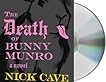
Fifteen years later, Cave’s second novel, The Death of Bunny Munro, is so bad it makes me scared to ever look at And the Ass Saw the Angel again for fear I might find out I was wrong. Bunny Munro is as short on plot as Angel was full, and the once complicated language has replaced its David Milch-style cadence and vocabulary for a pastiche of detective novels, riddled with clichés and lazy verbiage. Cave’s Bunny is an oily salesman who travels the road selling feminine beauty products and screwing his customers. His every moment is given over to some lurid fantasy, and as Cave quickly runs out of metaphors for his hero’s cock, they grow more and more tedious and loathsome. It’s no surprise that the book was a candidate for this year's Bad Sex in Fiction prize. I would be truly frightened to read the prose that beat it.
At the start of the book, Bunny’s wife, sick of his infidelity and fearing a killer that is plowing through England carrying a plastic pitchfork and wearing devil horns will come to her town, commits suicide, leaving Bunny alone with his 9-year-old son, Bunny Jr. He is a dreamy boy, with an affliction that makes his eyelids sting so that the very act of looking at the world hurts him. Obviously, this is a book that deals in heavy-handed metaphors. Is it any surprise that the killer’s horns turn out to be real? Boy and father go on the road, with Bunny showing Jr. the ropes while descending deeper into his personal, often surreal hell. I suppose it was Cave’s intention to drag us into hell with him; in that, he succeeds. Reading the book becomes an eternity of punishment.
The book was only made bearable thanks to the audio. For one, there is a some fantastic original music by Cave and his regular composing partner, Warren Ellis. Two, Cave is a fantastic reader, and his deep tones are wonderful to listen to. I’d love to hear him reading a better book than this one. If he can’t write it, I’d be fine if he read from the work of someone else.
Current Soundtrack: Grizzly Bear, "Deep Blue Sea" and Verkatimest
Saturday, January 30, 2010
HOW TO DISAPPEAR COMPLETELY
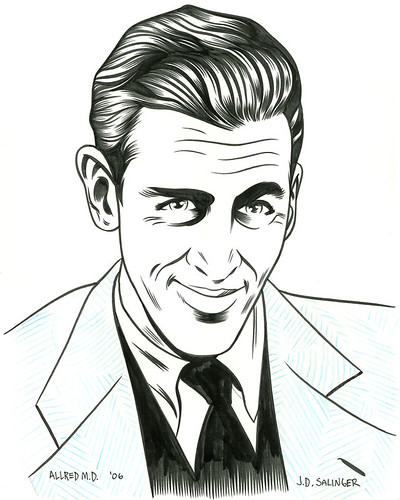
Anyone know who did this drawing? I took it from here.
It was by some strange coincidence that, earlier this week, just days before the news came out that J.D. Salinger had died, I was contacted on Facebook by an old friend who I hadn't talked to since probably 1992 or thereabouts. She had starred with me in a senior project I had done in high school, playing Franny opposite my Zooey in a video adaptation of the back half of my favorite of Salinger's four books, Franny and Zooey. It was an effort as ambitious as it was amateur. Filming two people talking on the phone is more complicated than you think. Particularly if you consider that my Franny had broken her leg or sprained her ankle or something similar, and we had to shoot her scenes with her sitting in bed, the offending corrective wardrobe buried under her mother's bedspread. We were both in drama and at that time were preparing for a production of Inherit the Wind. I was growing my dyed black hair out to go back to my natural color to play the lawyer Henry Drummond, and I was sporting a tiny ponytail that I tried to tell myself was a samurai-style topknot--something I desperately wanted to hide. In the school play, fittingly enough, Franny played the little girl who, at the end of the first act of Inherit the Wind, sees my character and runs away screaming, "Eeeek! The devil!" Life and its coincidences, life and its ironies.
Finishing the project took a sad turn worthy of Salinger. It took me something like 24 hours to edit the twenty-minute movie, working with my video camera and two VCRs. Even if we'd had a computer at my house, this was well before iMovie, and it was labor intensive, fast forwarding and rewinding to find the right clip, hoping to properly time the jump from pause to record and not get a rough, shaky cut. When I finally emerged from my room, which was tucked away in the garage, I was eager to show someone, and so I grabbed my father. He watched it patiently, and when it was all through, I eagerly looked to him for some kind of approval. He paused, and then spoke in sober, gruff tones. "Do you have to say ‘goddamn' so much?'"
"Well, yes," I whined, "that's the way it is in the book, those aren't my words, those are his words."
He didn't see why I couldn't have censored the language, I couldn't see why he couldn't see how hard I worked. The damage was done. Fittingly, at some point in the future, I had a vivid dream where my father tore up a copy of Catcher in the Rye, ripping it in half like a strongman attacking a phone book. I cried and argued and tried to make him understand that the book was me, he was tearing me in half. As one-sided as the dream was, it led to a teenage epiphany: he and I were so worried about the other guy not understanding us, we never bothered to try to understand one another. We were too caught up in our own junk to realize we were on common ground.
I first read Catcher in the Rye when I was sixteen. I was waiting for a then unrequited girlfriend to get out of some after-school activity she was involved in. I was going to drive her home. A beat-up copy of Salinger's novel, with its all-too-familiar burgundy cover, had been dropped in the school parking lot. I retrieved it from the asphalt and sat on the trunk of my car and read at least half the book before the girl arrived. There was no looking back after that. Like countless other adolescents, I was immediately a best friend of Holden Caulfield. Hell, the book even had a fart joke, that bit about Marsalla ripping one in chapel and really blowing the roof of. Nothing my English teachers ever assigned me had fart jokes.
For all the talk of Fitzgerald and Hemingway that dominated my college experience, the way they were the polar opposites, the two styles of writing, the lyrical and the manly, with Faulkner in the arty middle (the lit version of the Beatles, the Stones, and the Who; or more currently, Blur, Oasis, and Pulp), I would actually argue that no 20th Century American Author had a more profound and ubiquitous influence than J.D. Salinger. I learned a great deal from him, developed my love for italics and for hyperactive speech from reading his books. Every author whose debut novel is a first-person narrative about a transition out of innocence is really just covering Catcher in the Rye the way other kids sat in their garage and tried to learn how to play "Satisfaction." Without Holden Caulfield, let's be honest, there would be no Cut My Hair.
When you know Salinger's work you will begin to see it everywhere. It's like a secret language. Fans lay coded messages for other fans to find. Nick Hornby owes a pretty obvious debt, for instance. Wes Anderson is the most notorious admirer, his Tenenbaums being his own version of the Glass family, the child prodigies that run through all of his post-Catcher stories. I've also always suspected that William H. Macy's Donnie the Whiz Kid in Magnolia was Paul Thomas Anderson's nod to Zooey's talk about how the Glass children were quiz show regulars. Of course, I've never made a secret of my own reverence of those tales. It's what gave birth to the shared universe of my novels.
That's actually one aspect of Salinger's writing that I don't think gets enough consideration: his creation of a complete world. Much is always made of his conversational prose and his acute understanding of existential angst, but people don't talk as much about the way his books come as a complete, immersive, insular environment. The Glasses and Holden exist in a real, recognizable world, but it's one they've terraformed to fit their peculiarities. It's as if they occupy a definite spot on a map, and within their personal perimeter, everything is molded to their philosophy and their aesthetics, and beyond those lines lies the rest of society, with their screwed-up ideas and bad taste. This is probably the main thing Wes Anderson has taken from Salinger. It's the way that the Tenenbaums live in New York, but how New York seems to regress in time all around them. Or consider Max Fischer's journey in Rushmore, from a private domain he can control to the inner city where the rest of life grows unruly and wild, with no concern to how he sees things.
It's been said that Salinger has been more famous in recent years for not writing than he has for what he'd already wrote. He abandoned the publishing world and polite society in general in 1965, preferring to live a secluded life away from the glare of the public eye. He never published again, though there have been rumors that he has been working the whole time. We don't really know. There has been much said about the legendary old crank and none of it is really verifiable--though I am sure now that the vaults are left unguarded, we will find out. There is even a comprehensive book/documentary project about to be unveiled that, had J.D. not already died, well, the scope of this would kill him. (And if it didn't, the prospect of a Catcher in the Rye movie would. How stupid is Hollywood? Plenty stupid.)
Naturally, I am pretty sympathetic to the man in exile. My own work is full of men who try to run away, to escape, and find some peace alone. It's a theme partially inspired by Salinger, but more of a common ground that I found between him and I (and, to a degree, my own father) than something that I developed because of his work. It would still be there without Salinger's example, but it wouldn't be the same. (Particularly not Have You Seen the Horizon Lately?.) Most people don't believe me, but the truth is, I'd be perfectly content to recede into my armchair and fade completely away, never to be seen again. It makes me more than a little sad to see the final photo of Salinger (I won't link to it), a snooping photographer capturing the author in mid-angry protest. He looks like something out of a horror movie, like an extra from Carnival of Souls or the crazy old man in Equinox. If Salinger knew anything about current technology and the very un-private state of the modern world, I am sure he counted his lucky stars that he got out when he did. If he had any inkling that his time was short, it's probably not too far-fetched to think he burned any unpublished manuscripts himself, well in advance of the literary grave robbers coming to sift through the ashes. I can't pretend I won't read any books that may be published posthumously; when it comes down to it, I'm a phony and my high horse is a pony. I wish I could prove to my hero that he should have had more faith in humanity, but I can't. He was right about us.
And say what you want about his self-chosen banishment, but I think unlike any other author, even moreso than Hemingway's big game hunting and knuckle-dusting or Jay McInerney and Bret Easton Ellis' excesses, J.D. Salinger really did live out his work. Like any number of his characters, he chose to get out of it rather than let the world outside tell him who to be. If I had to pick one theory, I'd say he was a man who saw that his audience and the people who made money off of him were never going to let him grow up. They were never going to allow him to mature, not if they could keep him as the same rebellious adolescent. I'm sure he was asked "When are you going to write another Catcher in the Rye?" more times than there are numbers to count them. Hell, I'm nobody and I've had serious people tell me I needed to write another Cut My Hair and then have no idea why I am offended. As if they'd like to get in a time machine and return to whatever fast food counter they worked behind in the 1990s.*
J.D. Salinger was a man who would not be owned. Think about that before you get too eager to see what he had hidden under his bed. Think about that idiot boss you had once upon a time who demanded more of you than you wanted to give, and then realize that we were all J.D. Salinger's idiot boss and that he told us to get bent. And then remember that he did amazing work, everything we could have asked from him, and it still sits on our bookshelves, ready to be endlessly revisited, always offering more to be discovered. Because when you get to the heart of it, J.D. Salinger never stopped giving, the books never stopped offering up their treasures, we were just too selfish to be content with that. In literary heaven, Holden and Seymour and Franny, they all look at us and despair at how little we learned from their example.
* The analogy is intended as disrespect to the people making the suggestion, not to my book.
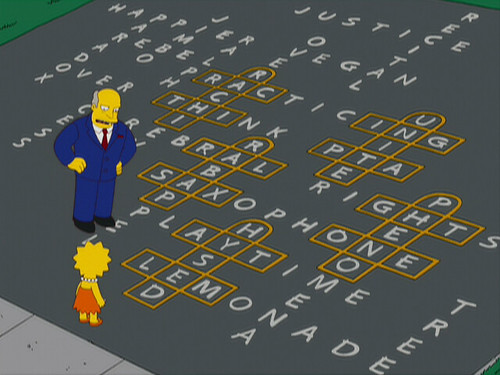
This image was one I hadn't used in a recent review, and it seemed apropos for some reason. Bart Simpson is the more obvious choice for a Holden Caulfield doppelganger, but Bart is not misunderstood, nor does he see through the world's false promises. It's Lisa who no one understands, who has a clear idea of how the world really is, and who sees things in her own way. This image shows not just how she sees things, but her actively trying to impose her sense of order on her environment.
Current Soundtrack:Radiohead; Bat for Lashes, "Pearl's Dream;" A Camp, "Stronger than Jesus;" The Verve, "Never Wanna See You Cry;" Sister Vanilla, "TOTP;" Brett Anderson, "The Big Time (Live in London);" and too many more to keep track of
There are many things that Stieg Larsson does well in this book. One is handling a massive plot, with all kinds of tangents and tributaries, and never becoming overly encumbered by any of it. I never once felt like he was doing something because it was required to advance the story or taking me too far away from the central conflict. This is rather surprising when you consider how didactic his writing style can be. There is a scene in the book where Lisbeth Salander, his altogether unique semi-private investigator, prepares to send an e-mail, and he details the make of her computer, the programs she uses, and just about every other technical element that goes into this action. It makes sense for Lisbeth Salander, though, the way it made sense for the scientific specificity Ian McEwan used in Enduring Love, but oh what a difference it makes when you like the character.
The central mystery is fairly intriguing, with enough twists and turns and red herrings to warrant one's interest, but the character of Salander is the real attraction of the book. She is one of the stranger protagonists you'll find, She's cold, asocial, and morally ambiguous. Her whole persona is "stay the fuck away from me," and yet you somehow adore her at the end and even feel sorry for her. To be honest, I didn't expect her to survive the novel, for some reason the plot description I read once upon a time made me think she was going to be the murder victim, but I'm glad now to know that she's in the other books (not sure if she's the titular girl in all of them).
There is a movie version on the way, Cinema 21 has it booked for the coming months. It'll be interesting to see how they contain the plot...and how they contain the main character. That's going to be a tall order.
I was drawn to read this book after seeing Tom Ford's film adaptation. The movie was so good, the narrative so personal and the images singularly beautiful, it made me want to know what kind of prose had inspired it. In that, Christopher Isherwood's way with words does not disappoint. His descriptions are vivid and poetic, telling us as much about the person who is viewing the surroundings as they do the surroundings themselves. The setting is actually pretty interesting: Southern California in the 1960s, a world in the midst of change, the very land being transformed by modernity. The main character, an aging professor, is of a different age, his obsolescence growing more pronounced by the paragraph. The world is passing him by.
Making it all the more interesting is that he is a man who was never part of the world, anyway. As a gay man, he was always outside whatever was normal or modern. A Single Man essentially chronicles a day in his life. George is lonely, grieving for his dead lover, enraged at the life that trundles on around. The pettiness of the inconsequential existences society chooses to accept as "regular" is not lost at him, and Isherwood lets George's interior invective flow. Interestingly enough, Ford teased a whole other story out of this, one that is more about the grief and also more sexual. Isherwood, who published this book in 1964, does nothing to hide George's gayness, but in the movie, it's like someone has struck the professor's libido with a tuning fork. No one is deaf to his desire. Ford also decides to make the day he depicts the one where George has decided to die, giving the film and otherworldy gravitas the book does not have. Instead, what makes the novel vibrant is George's incisive dissection of social drives and mores, and in the climax, when he declares his own somewhat tragic, some might say pathetic, position within those strictures, his acceptance opens the door hope and healing. It's interesting to note that though they take very different paths, both the original novel and the movie end up in the same place. The one distinct difference is that Tom Ford makes literal what is metaphor in Christopher Isherwood's ending, and Isherwood's images here resonate with much more strength than the movie's final scene.
I've been a fan of Yoko Ogawa's since some short stories I read in the New Yorker, and this is her first novel to be translated into English. Her prose is simple and elegant, and the story here reflects that. Actually, it's as unassuming as the title, and yet it is surprisingly deep and affecting.
The basic story is that the Housekeeper is a single mother who works as a maid to care for her ten-year-old boy. One day, she is assigned to a difficult case: a mathematics Professor with special needs. A car accident in 1975 left him with a short-term memory that resets every 80 minutes, so for him it is always the day before the accident. Yet, his mind is still sharp, and his stories and explanations about math reveal to the Housekeeper a whole new way of looking at the world. Numbers connect everything, and they explain everything. The way the math is presented in the story is easy to understand, even to a dunderhead like me. Ogawa makes sure the reason for any particular theorem is clear to the reader. Each idea is essential to the story.
When the Housekeeper first brings her son to the house, she discovers the Professor has an affection for children. The young man and the old man bond over baseball, and there is a particularly good chapter where they take the Professor to his first ever game, a uniquely problematic thing, he rarely leaves his house for a reason. Plus, they have to concoct explanations for why his favorite player won't be pitching that day, because they can't tell him he's retired.
The main throughline of the book is the connection between these people, of the family they form, and the transience of their bond forcing them to savor every moment. Ogawa avoids Western pitfalls--there is no romance, there isn't a cataclysmic accident that transforms them all suddenly--life just eventually takes its course. The difference for them is that they have now become constants, they are corresponding numbers. It's a shame Yasujiro Ozu is no longer alive, he could make a hell of a movie out of The Housekeeper and the Professor.
Author of prose novels and comic books like Cut My Hair, It Girl & the Atomics, You Have Killed Me, and 12 Reasons Why I Love Her. Jamie's most recent novel is the serialized book Bobby Pins and Mary Janes, and his most recent graphic novels are the sci-fi romance A Boy and a Girl with Natalie Nourigat; Madame Frankenstein with Megan Levens; and the weird crime comic Archer Coe & the Thousand Natural Shocks with Dan Christensen.




 was the fuzziest of pet projects for me. That book marked the end of a certain phase of her career, and since then, I've been able to watch and read as a fan as Renee's cartooning has continued to roam into new and unexpected places.
 reads like a delivery on everything she has done this century. In comparison, books like
 and the oddly delightful
 appear now as if they were bathroom mirrors fogged over by steam, and H Day is the reflection we find waiting for us when the glass is wiped clean.


 published last year, and it's coming out in paperback this month. I'm going to have to read that.


 , and he also set me up with my readings at Powell's Books over the years. That said, those are favors that are behind me, I totally took and I ran and I could easily get away with trashing the guy's book if I wanted. Which is my was of saying you can trust me, I have nothing to gain here. A Common Pornography is some good reading.

 . I remember being enthralled by his lush, complex sentences and his stark imagery. Looking back, perhaps it was the right time for me to read a tale of a strange boy stuck in a private, angry world. (In some ways, it reminds me now of Iain Banks’s
 .) I enjoyed the novel so much that when I met Nick Cave, I had him sign the paperback rather than any of my CDs.
 , is so bad it makes me scared to ever look at And the Ass Saw the Angel again for fear I might find out I was wrong. Bunny Munro is as short on plot as Angel was full, and the once complicated language has replaced its David Milch-style cadence and vocabulary for a pastiche of detective novels, riddled with clichés and lazy verbiage. Cave’s Bunny is an oily salesman who travels the road selling feminine beauty products and screwing his customers. His every moment is given over to some lurid fantasy, and as Cave quickly runs out of metaphors for his hero’s cock, they grow more and more tedious and loathsome. It’s no surprise that the book was a candidate for this year's